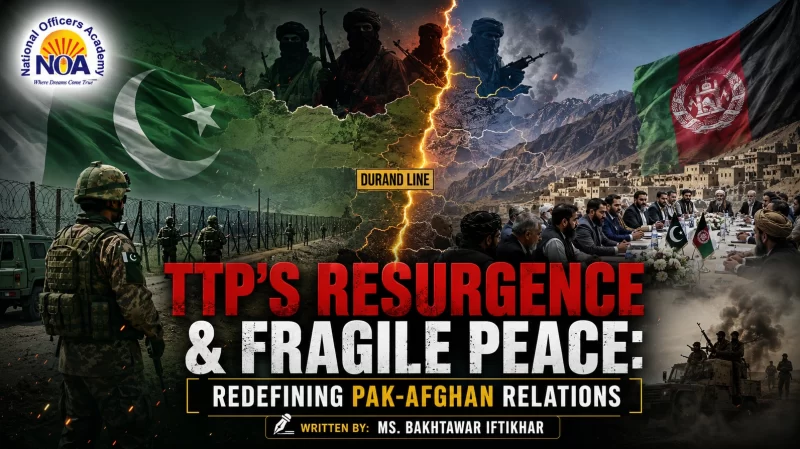
TTP’s Resurgence & Fragile Peace
Redefining Pak-Afghan Relations
Written By: Ms. Bakhtawar Iftikhar
Introduction
Among all the challenges threatening Pakistan’s national well-being, the revival of terrorism is the most pressing existential issue confronting the state.
The rise of terrorism has gained increasing attention in recent years. The growing number of attacks is a reminder of a painful past, one which neither the state nor its people wish to relive.
Tehrik-e-Taliban Pakistan is among the militant groups causing major national security concerns, primarily along the Pak-Afghan border.
This makes the merged districts and other parts of Khyber Pakhtunkhwa and Balochistan highly susceptible to attacks.
Resultantly, Pakistan finds itself in a tricky security environment, where the quest for peace involves a dual challenge: managing insecurity at home and maintaining a working relationship with its Afghan neighbour.
Resurgent Terrorism in 2024
According to the Pak Institute for Peace Studies, Pakistan experienced a total of 521 terrorist attacks in 2024, which reflects a 70% increase from the previous year.
The PIPS Security Report adds that out of the total 521 attacks in 2024, 335 were carried out by religiously inspired militant groups.
These groups mainly included Tehrik-e-Taliban Pakistan, affiliated local Taliban factions such as the Hafiz Gul Bahadur group and Lashkar-e-Islam, as well as Islamic State-Khorasan.
This was an increase from 208 such attacks in 2023.
As per PIPS, these attacks resulted in 520 deaths and left 633 others injured.
However, some other sources report over 1,600 Pakistani deaths as a consequence of insurgent violence at large.
Continuing into 2025
The trend appears to be continuing into 2025.
According to the Pakistan Institute for Conflict and Security Studies, around 35 incidents were recorded in the week of 21–27 March 2025.
March 2025 overall has been the deadliest month, with 105 militant attacks — the highest since November 2014.
Revival of TTP
TTP violence against Pakistan has spiked since the failure of negotiations between the group and Islamabad.
The danger posed by the militant group has also been recognized by around 18 U.S. agencies.
A 30-page report reflecting the U.S. intelligence community’s assessment notes that while the current attacks are aimed at Pakistan, they may emerge as a future threat to Washington.
The report stated:
“TTP’s capabilities, historical ties to al-Qaeda, and previous support to operations targeting the United States keep us concerned about the potential future threat.”
This indicates the extent to which TTP has revitalized itself.
The Khyber Pakhtunkhwa Front
Khyber Pakhtunkhwa has been on the receiving end of the largest share of TTP-induced insecurity.
The group has gained a foothold in pockets of the northwestern province, where around 10 out of 34 districts have an active TTP presence.
TTP has been behind several attacks on police stations and judicial courts in the provincial capital of Peshawar in the past.
In recent times, the January 2023 suicide blast targeting Police Lines Mosque was among the worst attacks.
Over 84 people were martyred, including 81 policemen.
Merged Districts
In the merged districts, which were previously part of the Federally Administered Tribal Areas, the twin districts of Waziristan, Khyber, Mohmand, Bajaur, Bannu, and Lakki Marwat are particularly vulnerable to terrorist attacks.
In recent times, attacks have risen drastically.
Heavy fighting and terrorist activities are seen frequently.
For example, on 20 September 2024, six soldiers were martyred and 14 injured in a crossfire at the northwestern border in North Waziristan.
Between 4 and 5 October, insurgents attacked a military fleet in North Waziristan district, resulting in the deaths of six soldiers, according to Inter-Services Public Relations.
Bannu has also been the target of a series of attacks.
Improvised explosive devices, rocket-propelled grenades, and ambush tactics have been the main techniques due to their ability to cause damage with minimal confrontation or from a distance.
The attacks have targeted police stations and even an under-construction building of a primary school for girls.
The 15 July 2024 attack on Bannu Cantonment resulted in the martyrdom of eight security personnel and injured several others.
Pakistan served Afghanistan a strong demarche following this attack.
A double suicide attack at the cantonment gates was also carried out during Ramadan on 4 March 2025 by Jaish Al-Fursan, a militant group affiliated with the Pakistani Taliban.
UNICEF condemned this attack, which claimed the lives of five children, the youngest a one-year-old boy, and injured several women and children.
In the same vein, Lakki Marwat and its population of around one million are reportedly subject to TTP’s control in certain areas, where local authority is said to have been replaced.
A resident from Lakki Marwat stated:
“They want to limit our lives here the same way the Afghan Taliban did in their country.”
Consequently, the movement of women is restricted in some areas, girls’ schools are forced to close, music is banned, and even barbers are barred from trimming or shaving men’s beards.
Locals for Peace
The locals in Khyber Pakhtunkhwa have outrightly rejected the extremist agenda.
They have come out in peaceful protests against the spotted presence of TTP.
Thousands took to the streets in Swat, protesting against signs of unrest returning to the area.
Thus, public support has been denied to the TTP in Malakand and other areas.
The public is weary of the threat of militancy and instability and demands the restoration of peace.
The Baluchistan Front
Terror attacks are also on the rise in Baluchistan.
Major trends on the Baluchistan front are as follows.
Organisational Restructuring
TTP in Baluchistan has split its organizational structure into two units or wilayahs.
These separate Baloch and Pashtun areas under the Zhob and Qalat-Makran wilayahs respectively.
This strategy helps TTP gain a stronger foothold and consolidate its presence if the Khyber Pakhtunkhwa front becomes unviable for regrouping.
Media Messaging
TTP’s media campaign, led by Umar Media, has also been sympathizing with what are popularly known as Baloch grievances.
The group has published statements through Majallah Tehreek-e-Taliban Pakistan, TTP’s Urdu propaganda magazine, on issues such as enforced disappearances and water-borne diseases in Dera Bugti after floods.
It also published a nasheed in Balochi with Urdu subtitles reflecting these issues.
Alliance with Ethno-Separatist Groups like BLA
On 9 November 2024, a bomb explosion at Quetta Railway Station claimed the lives of 16 people and injured 30 others.
While the separatist group Baloch Liberation Army claimed responsibility for this attack, some analysts speculate that the BLA and TTP may be coming together against the Pakistani state.
A report in Dawn observed:
“Since Mufti Noor Wali Mehsud took charge of the TTP in 2018, we’ve observed a clear shift, with the TTP repeatedly justifying the Baloch armed struggle against the state. Initially, Baloch secular nationalists were known to resist and even clash with Islamist jihadists in Balochistan, such as the Baloch chapter of Lashkar-i-Jhangvi, but that division has faded away now. Baloch militants no longer oppose jihadists, and similarly, the TTP leadership now openly justifies the Baloch armed struggle. The group also previously issued videos in the Balochi language in April and May 2022, urging the Baloch to support its war against the state.”
This emerging convergence between militant and separatist trends complicates Pakistan’s internal security landscape.
Targeting Chinese Workers
Terrorist threats to the security of Chinese workers have also increased.
These attacks aim to hinder the development of Chinese-funded projects in Balochistan and Khyber Pakhtunkhwa, and ultimately across Pakistan.
The Khyber Pakhtunkhwa Counter-Terrorism Department confirmed that the terror attack in Besham, which killed five Chinese nationals, was backed by Tehrik-e-Taliban Pakistan.
Earlier suicide attacks in Dasu, which killed Chinese engineers, also prompted international concern and compelled Pakistan to heighten security measures for Chinese citizens in Pakistan.
TTP Broadening the List of Targets
The new general Code of Conduct introduced by TTP has broadened the list of “legitimate targets.”
These include government institutions, the judiciary, and political entities outside religious parties, notably evident in the January 2025 threats against PML-N.
Other groups at risk include tribal peace committees and those accused of obscenity or blasphemy.
Contrary to TTP claims of not targeting certain sects indiscriminately, there is room for sectarian violence as well.
Fundraising Through Digital Currency
Similar to many global extremist organizations, TTP is now exploiting digital currencies for financing.
Social media accounts linked to the group are raising funds and asking for donations through QR codes linked to crypto wallets.
Previously, Pakistan curbed terror financing when the group relied on hawala networks and cash transactions.
These new methods call for renewed regulatory and monitoring mechanisms.
TTP and the Afghan Taliban
An emboldened TTP points to close ties between Tehrik-e-Taliban Pakistan and the Afghan Taliban, as also noted by a United Nations report on the Afghan Interim Government.
The Afghan Taliban released several TTP prisoners after coming to power, and TTP swore allegiance to the Emir of the Islamic Emirate of Afghanistan.
The Taliban’s win against the United States was seen as a success story, with Noor Wali Mehsud seeking to follow in the footsteps of the Afghan Taliban in their fight against the Pakistani state.
The approach of appointing shadow governors and creating a centralized military training system has been borrowed accordingly.
The pro-TTP lobby within the Afghan Taliban uses the shared history and sentiment regarding “jihad against the U.S.” to receive support.
Therefore, the return of the Taliban to Afghanistan’s power corridors has provided the TTP with greater operational freedom.
As a result, their attacks are becoming more lethal, sophisticated, and numerous.
This has also allowed TTP access to remnants of NATO weaponry, including small arms and night-vision technology, which grant the militant group a significant advantage.
Pakistan’s former Special Envoy for Afghanistan, Ambassador Asif Durrani, also pointed out that the Taliban misuse Pashtunwali, the traditional Pashtun code of conduct, as an excuse for not taking decisive action against TTP.
Speaking at a conference in Islamabad, he explained that no “guests” can be surrendered, but no guests should use the home of their hosts to carry out terrorist activities.
Impact on Pak-Afghan Relations
The aforementioned trends and numerous attacks are sounding alarm bells in Pakistan’s policy circles.
The Taliban interim government is ostensibly paying little heed to Pakistan’s requests to prevent Afghan soil from being used as a staging ground for terrorism.
Consequently, the scenario is taking a toll on Pak-Afghan relations.
Repatriation of Refugees
Pakistan’s refugee repatriation move was largely interpreted as a tactic to pressure the Afghan government, given its lack of cooperation regarding countering TTP.
Press conferences by government officials during this period also cited the involvement of Afghan nationals in suicide bombings as justification for the policy.
Despite heavy criticism from the media, Pakistan insisted that the Illegal Foreigner Repatriation Plan 2023 applied to all illegal foreigners, according to the official narrative.
Mass deportations are expected to continue after the expiration of deadlines given in the multistage plan targeting nearly three million Afghans residing in Pakistan.
Pakistan’s Interior Ministry stated that no one would be maltreated and that arrangements for food and healthcare had also been put in place.
Still, the optics have damaged relations between the two neighbours.
Cross-Border Operation
Despite repeated efforts to persuade Afghan Taliban leadership to ensure that Afghan territory is not used to carry out terrorist activities against any state, in accordance with the Doha Agreement, the de facto rulers have not taken adequate measures to stop the threat.
Consequently, Pakistan conducted a cross-border intelligence-based operation targeting the Hafiz Gul Bahadur Group, which had attacked a security post in Mir Ali, North Waziristan.
This operation was a direct response to the persistent threat posed by militant groups operating from Afghan territory.
Regulating Border Trade
Pakistan also added Afghan items to a negative list and began streamlining and regulating the movement of cargo engaged in bilateral trade.
The resulting decline in trade is attributed to import restrictions and anti-smuggling measures.
These measures are necessary for Pakistan in times of security crisis, but they add to the tense political climate.
Border Closure
There have been several instances when the border was closed.
For example, on 6 September 2023, Afghan troops claimed they were repairing an old security post.
Pakistani officials condemned Afghan troops’ “indiscriminate firing,” which targeted Pakistani military posts, damaged infrastructure at the Torkham Border Terminal, and put the lives of both Pakistani and Afghan civilians at risk.
This happened when Afghan troops were stopped from erecting such unlawful structures.
Pakistani officials stated that the unprovoked firing emboldened terrorist elements.
In addition to such clashes, the border was also closed at other times to implement the repatriation plan.
In both scenarios, border closures caused significant concern for Afghan traders and added stress to trade, economic, and transit ties between the two states.
Moreover, this approach appears to chip away at goodwill between the Pakistani and Afghan governments, with people on both sides expressing agitation against trade restrictions and border closures.
Maintaining a Working Relationship Amid Security Imperatives
Given the importance accorded to sovereignty and territorial integrity, Pakistan’s Ministry of Foreign Affairs has repeatedly expressed that Pakistan prioritizes dialogue and cooperation.
Accordingly, Pakistan has urged the interim Afghan government to deny safe havens to TTP and surrender its leadership to Pakistan.
It is crucial to continue advocating for Afghan Taliban cooperation in counterterrorism measures in order to preserve regional peace and stability.
Goodwill can also be established by decoupling politics and trade, with the hope that economic cooperation may strengthen bilateral ties at large.
Recently, positive developments offered some hope as Pakistan’s Special Representative for Afghanistan, Ambassador Muhammad Sadiq, visited Kabul to de-escalate tensions.
The Torkham border was also reopened after a 27-day closure.
Despite rifts in the bilateral relationship, the two neighbours must acknowledge the importance of cordial ties.
Although Kabul may have found other partners to engage with, it is essential to remember that despite current irritants, Pakistan remains Afghanistan’s closest, most accessible, and economically viable neighbour.
To foster cooperation, address current issues, and create space for increased engagement, there is a need for mutual commitment to peace and respect for sovereignty.
Thus, consistent diplomatic engagement and dialogue are indispensable to pacify the irritants in Pak-Afghan relations.
Finding Peace: A Holistic Approach
Though engaging the Afghan government is important, countering the menace of terrorism also requires a holistic response at home.
Internal course correction is urgently needed to fill gaps and compensate for past inconsistency and lack of implementation of devised policies.
In these turbulent times, one of the most important aspects of dealing with the security crisis is to ensure that the gap between the state and the masses does not widen.
Gaps in national and local governance structures are exploited by malicious groups.
A trust deficit and poor socio-economic indicators grant these groups fertile ground.
Thus, efficient service delivery must be ensured at any cost.
Even as crucial kinetic measures are taken, it must be remembered that military operations do not win a war; they only create an environment for winning the war.
A surgical approach to the challenge can help minimize backlash and ensure that military operations do not exacerbate existing grievances in peripheral areas.
These steps should also be supplemented by efforts to de-weaponize the merged districts and strengthen the internal law enforcement agencies of the state.
In recognition of the challenge, Pakistan has initiated a series of measures. However, their effectiveness will depend on the extent to which they are coherently and impartially implemented.
Conclusion
TTP’s resurgence has redefined the security and diplomatic landscape of Pakistan’s western frontier.
The rise in terrorist attacks across Khyber Pakhtunkhwa and Balochistan, the group’s links with the Afghan Taliban, and its use of new financing and propaganda tools have made the threat more complex than before.
At the same time, Pakistan’s relations with Afghanistan have become increasingly strained due to border closures, refugee repatriation, trade restrictions, and cross-border operations.
Yet, both countries cannot afford permanent hostility.
Pakistan needs Afghan cooperation to deny safe havens to militant groups, while Afghanistan needs Pakistan for trade, transit, and regional connectivity.
The way forward requires a balance between firm security measures and sustained diplomatic engagement.
Pakistan must strengthen its internal governance, improve service delivery in vulnerable regions, modernize law enforcement, and continue pressing Kabul for meaningful counterterrorism cooperation.
Only a holistic approach combining security, diplomacy, economic engagement, and public trust can help Pakistan confront the TTP threat and stabilize Pak-Afghan relations.