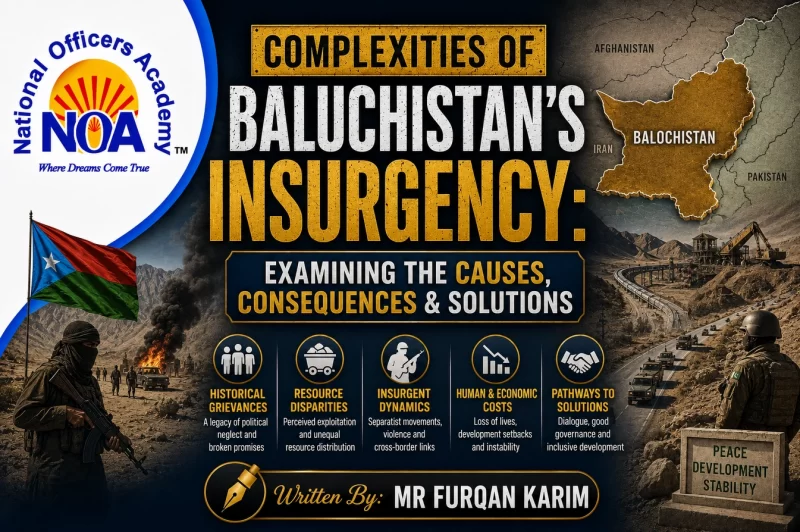
Complexities of Baluchistan’s Insurgency
Examining the Causes, Consequences & Solutions
Written By: Mr Furqan Karim
Introduction
Baluchistan, which makes up more than 40% of Pakistan’s total landmass, is gifted with vast natural resources. Yet, despite its strategic importance and resource wealth, the province has been facing recurring insurgencies.
The insurgent groups involved in these conflicts have carried out terrorist attacks on security forces, settlers, state infrastructure, Chinese nationals, and CPEC-related projects.
In response, the state has often opted for military operations in the province.
These conflicts between Baloch insurgent elements and the state have severely impacted the socio-economic fabric of Baluchistan.
Historical Background
The Baluchistan insurgency began in 1947 when Kalat, under Ahmad Yar Khan, joined Pakistan. This decision sparked opposition from his brother, Prince Abdul Karim.
This led to a brief revolt in 1948, marked by Baloch attacks on the Pakistani army. However, the revolt lacked broad support.
Tensions rose again with the 1956 Constitution, which reduced provincial autonomy, and with the One Unit policy.
From 1958 to 1959, Nawab Nauroz Khan led a guerrilla campaign against the state but was later arrested.
In the 1960s, dissatisfaction with the One Unit policy further fueled the Baloch separatist movement.
From 1963 to 1969, Sher Muhammad Bijrani Marri led a guerrilla campaign for a share in Sui gas revenues. This phase ended in a ceasefire.
Tensions flared again in the 1970s after President Zulfikar Ali Bhutto dismissed provincial governments and imposed martial law, sparking a new insurgency.
The Baluchistan People’s Liberation Front, led by Khair Bakhsh Marri, fought against the state. This insurgency later subsided after the restoration of the four-province structure and the abolition of the Sardari system.
A 2021 PIPS report stated that Baluchistan was still severely affected by violence, with 136 deaths in 81 attacks by groups such as the BLA and BRA.
In early 2022, attacks escalated, including bombings in Bolan and an attack on a military post in Kech. By the end of January, 17 people were killed and 32 injured.
Violence continued in February and March, with more attacks on security forces in Quetta, Sibi, and Dera Murad Jamali.
Bombings before the 2024 elections also killed dozens, showing that the insurgency remained a serious challenge.
Recent Developments Since 2024
The insurgency in Baluchistan has notably increased over the past year, particularly with the Baluchistan Liberation Army amplifying the scale and sophistication of its terrorist attacks.
In August 2024, the BLA initiated “Operation Herof,” a series of coordinated attacks targeting military installations and civilians.
A particularly significant incident involved the killing of 23 ethnic Punjabis in Musakhail District. This reflected the insurgents’ tactic of ethnic warfare.
In October 2024, a vicious attack on coal miners in Duki District led to 21 fatalities.
Although no group claimed responsibility for the assault, it exacerbated fears among local workers.
In November 2024, a suicide bombing at the Quetta railway station resulted in 32 deaths and 55 injuries.
The Majeed Brigade of the BLA took credit for this terrorist attack, marking its first strike in central Quetta and displaying an expansion in operational reach.
The boldest incident occurred in March 2025, when BLA militants attacked the Jaffar Express travelling from Quetta to Peshawar.
The insurgents used explosives to stop the train in a remote mountainous area of Bolan and took hundreds of passengers hostage.
Following a prolonged operation, Pakistani security forces were able to rescue most of the hostages.
However, 64 individuals, including 18 soldiers and all 33 attackers, were confirmed dead.
This operation demonstrated the BLA’s capacity to execute complex missions and posed a significant challenge to the writ of the state in the province.
These incidents led to a surge in militant activities, with at least 84 attacks recorded during Ramadan 2025, the highest in ten years.
Analysts point to several factors, including the end of the Pakistani Taliban’s ceasefire and the BLA’s strengthened capabilities, potentially bolstered by external support.
The resurgence of the Baloch insurgency presents a multifaceted security dilemma for Pakistan. It requires a reassessment of military strategies and a deeper understanding of the socio-political factors fueling the unrest.
Causes of Baluchistan Insurgency Over Time
The insurgency in Baluchistan is driven by a complex mix of historical, political, ethnic, and economic factors.
Below are some of the primary causes of the ongoing conflict.
Involvement of External Elements
The involvement of India in Baluchistan is considered a major contributing factor to the insurgency in the region.
India is accused of supporting Baloch separatist groups through funding, training, and other forms of assistance, with the aim of destabilizing Pakistan and promoting insurgency in Baluchistan.
Indian intelligence agencies, particularly the Research and Analysis Wing, have allegedly been involved in supporting Baloch nationalist movements with the goal of weakening Pakistan’s territorial integrity.
In 2016, Kulbhushan Jadhav, an Indian intelligence officer, was arrested in Baluchistan.
In his confessional statement, he accepted RAW’s support for separatist groups such as the BLA, BRA, and others that remained involved in terrorist attacks in the province.
Resource Exploitation and Economic Disparities
Despite being rich in natural resources, including vast reserves of gas, copper, coal, and minerals, Baluchistan remains one of the poorest provinces in Pakistan.
Pakistan discovered gas reserves in Baluchistan in 1952.
Karachi, Lahore, and Rawalpindi received gas supply in 1960, but Quetta received it only in 1984, despite the fact that one of Pakistan’s largest natural gas reserves is located in Baluchistan.
The province receives a disproportionately small share of the revenue generated from gas.
Moreover, Baluchistan has not received its due share as royalty in projects being carried out in the province.
For example, in the Saindak copper mine project operated by Chinese company MCC, the province received only a 2% share until 2012 and 5% till date.
The province’s share under the National Finance Commission has also been a major concern.
These acts of resource exploitation and economic disparity have served as major causes of Baloch insurgency over time.
Lack of Political Autonomy
The lack of political autonomy in Baluchistan is a primary driver of the ongoing insurgency.
Despite its vast natural resources, Baluchistan has long been politically marginalized, with key decisions often made by Pakistan’s central government rather than local authorities.
This has contributed to widespread economic underdevelopment, with little benefit from the region’s wealth reaching the local population.
The Baloch people, who have a distinct ethnic and cultural identity, often feel alienated by state policies that suppress their language and traditions.
Coupled with human rights violations, these grievances have fueled nationalist sentiments and insurgent movements.
Many groups have demanded greater autonomy, while some have called for full independence.
Implications of the Baloch Insurgency on Pakistan
The Baloch insurgency has profound implications for Pakistan.
Security and Stability
There are frequent terrorist attacks on security forces, infrastructure, and civilians.
In response, law enforcement agencies have launched military operations.
This has led to a heavily militarized environment in Baluchistan, weakening national security and hindering effective governance.
Economic Impact
Baluchistan’s natural resources, including gas and oil, remain underexploited due to the insurgency.
Severe attacks on Chinese engineers and working personnel affect the development of CPEC.
Pakistan seeks multiple economic and developmental gains through CPEC, but the project continues to face the consequences of the Baloch insurgency.
Political and Governance Challenges
The insurgency deepens political instability.
Baloch grievances over underrepresentation and lack of autonomy continue to grow.
Islamabad’s military-led response has often exacerbated tensions, prevented political dialogue, and alienated the local population.
Human Rights Violations
Both insurgents and security forces have been accused of human rights abuses, including extrajudicial killings and forced disappearances.
The conflict has led to widespread displacement and social hardships for civilians.
Militancy and Extremism
The insurgency has contributed to broader militancy within Pakistan.
Some separatist groups have reportedly allied with extremist factions, further destabilizing the region.
This has complicated Pakistan’s overall internal security environment.
Policy Recommendations
To resolve the Baloch insurgency and address the underlying causes of discontent, Pakistan must adopt a multi-faceted approach that includes political, economic, and social reforms.
Intelligence-Based Military Operations
There is neither a need nor acceptability for major military operations.
Therefore, intelligence-based operations should be the preferred option for the state to deal with terrorist groups.
These operations must include police, paramilitary, and military personnel, with police and the Frontier Corps placed at the front and the military in the background.
Such operations should ensure no collateral damage, or at least the minimum possible collateral damage.
Educational and Social Reforms
The government should increase the literacy rate and improve educational infrastructure in Baluchistan.
Providing quality education will help reduce the sense of disenfranchisement and give future generations the tools to participate fully in the nation’s economic and political life.
The government should also invest in social welfare programmes targeting the most vulnerable populations in Baluchistan, including healthcare, nutrition, and housing.
By addressing basic human needs, the state can reduce the grievances that fuel unrest.
The government should also promote cultural exchange and recognition of Baloch traditions and values within the national fabric.
This can reduce the sense of marginalization and promote unity in diversity.
Political and Autonomy Reforms
Baluchistan should be granted more control over its resources, governance, and decision-making.
This includes devolving powers to the provincial government and allowing Baloch leaders to manage local affairs without undue interference from Islamabad.
The provincial government should also resolve the cases of missing persons.
Addressing this issue is essential for building trust and reducing alienation among the local population.
Economic Development and Resource Sharing
Baluchistan is rich in natural resources, including natural gas, minerals, and oil, but the province receives limited benefits from them.
A fair distribution of revenue generated from these resources is crucial.
This could involve increasing Baluchistan’s share of royalties from resource extraction and ensuring that the provincial government has control over its wealth.
Priority should also be given to investments in infrastructure, including roads, hospitals, schools, and electricity.
This would improve the quality of life and counter claims of neglect.
The government should focus on local employment opportunities through government-backed projects, especially in key sectors such as mining, energy, and construction, which are central to the province’s economy.
Dialogue and Peace Process
While security is essential, Pakistan must scale back large military operations in Baluchistan and transition toward a more peaceful approach focused on political solutions and community engagement.
The government should engage with Baloch nationalist groups and insurgent factions in meaningful and unconditional talks.
Respected neutral mediators should be involved to help broker negotiations.
All stakeholders must have a seat at the table, including political leaders, tribal chiefs, and insurgent groups.
The state should provide pathways for Baloch militants to lay down their arms and reintegrate into society through amnesty programmes, rehabilitation, and inclusion in the political process.
This could help reduce the appeal of armed insurgency.
Addressing External Influence
The government should reduce the external influence of India in heightening tensions between Baloch insurgent groups and the central government.
Pakistan should seek support from international platforms and request international bodies such as the United Nations and BRICS to use their influence in limiting India’s role in the country.
This diplomatic approach can help expose external interference while strengthening Pakistan’s position globally.
Conclusion
The insurgencies in Baluchistan have existed since the time of independence and escalated in different eras.
There are multiple causes behind the grievances of Baloch insurgents and the Pakistan government. These include historical grievances, economic disparity, ethnic problems, and alienation from political and administrative affairs of the state.
This conflict has created serious implications for Pakistan, including economic losses, human rights violations, ethnic and regional tensions, militancy, and extremism.
To resolve the Baloch insurgency, Pakistan needs a combination of political concessions, economic reforms, respect for human rights, and meaningful dialogue with Baloch nationalist groups.
This will require a long-term commitment to addressing the deep-rooted causes of unrest, including underdevelopment, political marginalization, and human rights violations.
By implementing these solutions, Pakistan can build a more inclusive and peaceful future for Baluchistan and the nation as a whole.