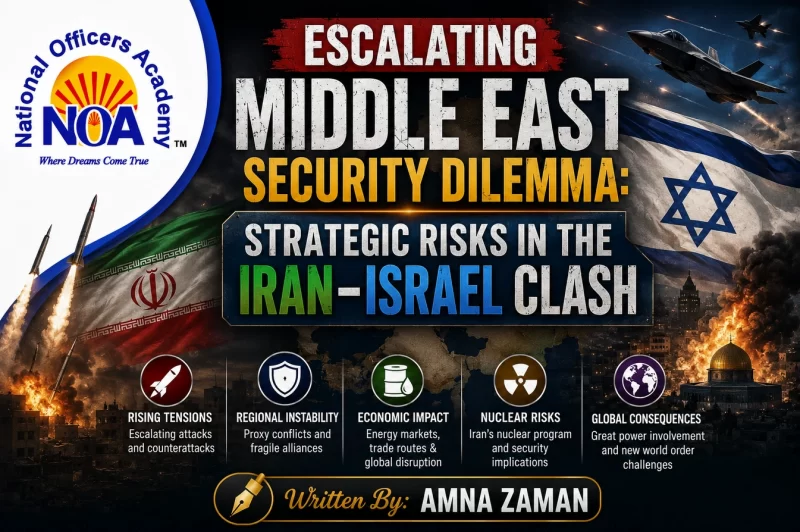
Escalating Middle East Security Dilemma
Strategic Risks in the Iran–Israel Clash
Written By: Amna Zaman
Introduction
The Middle East has always been one of the most sensitive regions in the world. One event of insecurity and chaos can shake the entire regional dynamics and disturb the existing global order.
The recent genocide of Palestinians since October 7, 2023, by Israel has proved to be a major spark for escalating crises in the region. The recent Iran–Israel conflict is an ignited fire from this underlying spark.
Strategic attacks between both adversaries took place. Israel carried out aerial strikes inside Iran, which were a clear violation of international law. Iran retaliated, but the conflict also exposed weaknesses and loopholes in its air force and defence system.
This conflict has unveiled the volatile and porous security shield of the region. It has also exposed deep internal weaknesses and discords, threatened energy trade, and raised concerns about its possible influence on global power dynamics.
Historical Background of Iran–Israel Relations
The relationship between Iran and Israel can be divided into four phases, showing a roller coaster of instability.
The first phase started from 1947 and continued till 1953. During this period, relations remained bitter. Iran stood against the British and United Nations decision regarding the inclusion of Israelis into Palestine. Iran was among the anti-Israel states out of thirteen states.
The second phase continued from 1953 till 1979. During this period, King Reza Shah Pahlavi established cordial ties with Israel.
However, in 1979, the pro-Western regime of Reza Shah Pahlavi was ousted by Iran’s first Supreme Leader, Ayatollah Ruhollah Khomeini. After the Iranian Revolution, post-revolution Iran maintained bitter relations with Tel Aviv.
Further adversarial relations peaked after the disintegration of the Soviet Union in 1991 and continued into contemporary times.
The series of attacks between both states in contemporary history has marked the possibility of bigger conventional warfare through a “domino effect.”
Unprecedented support for surgical strikes, proxy wars, attacks on ships, planes, military bases, and nuclear scientists became common practices.
Recent large-scale tensions expanded when Israel attacked on April 1, followed by Iranian retaliation on April 13, 2024.
The June 2025 Escalation
Full-scale attacks began in June 2025, when Israel launched a series of aerial attacks through F-35 and F-16 fighter jets.
These attacks targeted:
- Nuclear sites
- Missile installations
- Oil and gas fields
- High-profile scientists
- Military leadership
In return, Iran counter-attacked and targeted Israel’s seaport, military and intelligence setups, IT hubs, and even the residence of Israeli Prime Minister Benjamin Netanyahu.
This escalation marked a serious shift in the nature of the conflict, moving it from indirect confrontation and proxy warfare toward direct military exchange.
Nuclear Tensions and the Regional Security Dilemma
The International Atomic Energy Agency submitted a report in May 2025 stating that Iran had grossly violated enrichment capacities and expanded its nuclear arsenals.
The Israeli nuclear arsenal, backed by the United States and Western alliances, has raised a regional imbalance of power and a serious security dilemma. However, it remains largely acceptable to the international community.
On the other hand, the Iranian nuclear programme is not acceptable to Israel and the West. It is also perceived as a threat by Gulf Cooperation Council countries.
Iran’s nuclear programme, uranium enrichment, expansion of weaponry, development of cruise and ballistic missiles, and latest conventional warfare techniques have raised serious concerns and undermined regional peace.
Economic and nuclear sanctions on Iran have crippled its societal structure, yet its nuclear stand-off remains unchanged.
JCPOA, Trump’s Policy, and Failed Negotiations
The Joint Comprehensive Plan of Action was signed in 2015. It was called a historical deal by President Barack Obama but declared a historic blunder by Donald Trump.
Trump pulled the United States out of the deal in 2017.
After becoming president again in 2024, Trump expanded the process of negotiations with Iran on multiple fronts, including nuclear enrichment and proxy wars.
Oman played a major role in these negotiations.
The sixth round of talks was ongoing when strikes between both parties took place.
Israel was against any kind of negotiations with Iran. If these negotiations had succeeded, sanctions could have been removed and Iran could have come out of regional and global isolation. There was also a possibility that the United States might enter into working relations with Iran.
Netanyahu’s Political Pressures and the Iran Diversion
Benjamin Netanyahu has been facing opposition on multiple fronts.
Internally, he faced a vote of no-confidence against himself in the Knesset. In order to weaken that move, he successfully created a situation with Iran.
Due to genocide and war crimes in Gaza, European allies had become hesitant to support the criminal actions of Israel under the Netanyahu regime.
For the first time in contemporary history, the populations of the United States and Europe held protests in favour of Muslim victims.
A harsh and negative image of Netanyahu was projected globally. Diverting attention toward Iran seemed to be a useful step for him to reduce this pressure.
Israel’s Policy of Pre-Emptive Strikes
Israel implemented its official policy of “pre-emptive strikes” against all proxies and now against Iran.
This concept matured during the Bush era, mainly in 2003-04.
Practically, it was used by both Israel and Iran in strikes against each other. However, Israel gained more benefit from this concept in the recent escalation.
The attacks were unprecedented.
No official statement was initially given by Israel, but certain media reports suggested that missile strikes were carried out and F-35 fighter jets were used.
Israeli special forces also conducted operations inside Iran, including attacks in Tehran, nuclear facilities, military bases, journals, scientists, army chiefs, military commanders, and civilians.
These attacks claimed several precious and innocent lives.
Targeting Iran’s Nuclear Facilities
Nuclear facilities are mostly located underground. Iran’s main nuclear facilities are based in:
- Isfahan
- Natanz
- Fordow
- Arak
The exact depth of underground facilities is not known, but it is generally believed to be around 60 to 80 meters deep.
A simple missile is not enough to destroy such facilities. Bunker-buster bombs are required, which are owned by the United States and not by Israel.
According to The Security Brief Show by BBC News, nuclear sites in Isfahan were attacked by sea-based U.S. warships using Tomahawk land-attack missiles. These missiles travel at subsonic speed, can penetrate deeply, and are difficult to detect by radar.
Uncertainty Over Damage to Nuclear Installations
The dismantling of Iran’s nuclear installations is still doubtful.
The U.S. president claimed that the targeted reactors had been obliterated.
However, the Pentagon chief held a slightly different opinion and claimed that the sites had suffered severe damage.
Iran claimed that the sites were intact and that only the entrances were damaged.
The truth can only be established when IAEA observers inspect the sites. However, these observers had already left Iran on Tehran’s order.
If the damage is severe, it would be a serious setback to Iran’s nuclear capabilities.
On the other hand, it would also create a strong realization in Tehran that acquiring a nuclear bomb may be the only way to ensure deterrence for Iran.
Iran’s Weak Air Defence and Intelligence Failures
This war has exposed Iran’s weak air defence system and intelligence network.
Most Iranian fighter jets are from the 1970s, including F-14s and MiG-29s, often referred to as “flying coffins.”
Iran has fewer updated Russian jets such as the Su-30.
Iran’s anti-ballistic capabilities are also limited, consisting mainly of S-200 and S-300 Russian missile systems. These systems could not effectively intercept F-35 fighter jets and B-2 bombers.
Furthermore, the war exposed severe intelligence failures inside Iran.
Israel’s Mossad had penetrated deep into Iran and successfully attacked high-profile officials. It even operated drones from Iranian soil.
Iran’s Missile Capabilities and Strategic Retaliation
On the other hand, Iran has developed a home-grown missile system with the capability to breach multiple defence barriers and successfully attack Israel.
Both ballistic and hypersonic missiles of Iran managed to dodge Israel’s air defence system, which consists of four layers:
- Arrow-III
- Arrow-II
- David’s Sling
- Iron Dome
Iranian missiles also successfully crossed U.S. air defence systems in the Persian Gulf and the Red Sea.
These Iranian attacks created severe panic inside Israel, as a series of missiles targeted strategic installations inside the country.
The Israeli population was forced to live in bunkers for twelve long days. Many Jews also fled Israel.
All these developments probably pressured Netanyahu to ask Trump for a ceasefire.
Regional Security Threats and Energy Routes
This war did not affect only Iran and Israel. It threatened the security of the entire region.
In response to U.S. strikes on Iran’s nuclear sites, Tehran launched missile strikes on U.S. military bases in Iraq and Qatar.
The United States clearly understands Iran’s capability to strike targets and to block the Strait of Hormuz in the Persian Gulf.
Iran also has the ability to disturb the smooth functioning of the Strait of Aden in the Red Sea with the help of its proxy in Yemen, the Houthis.
This would be unprecedented for the world economy because these two gateways are major trade and energy routes.
Any disruption would hit the economies of Europe, China, India, and the rest of the world.
Impact on Global Power Politics
This war has multiple impacts on global power politics.
First, the limitations of Russia have once again surfaced.
Russia could not militarily support Iran because it has been stuck in a prolonged and expensive war in Ukraine. It has also been facing severe sanctions from the West.
Second, an idea among China’s allies has been reinforced: Beijing does not jump into war for the sake of allies in the same way that the United States often does.
This is due to China’s policy of avoiding war, peacefully co-existing with neighbours and world powers, focusing on economic growth, and continuing military buildup.
There is also a possibility that China and Russia may want the United States to jump into yet another prolonged war in order to weaken U.S. capabilities as a global hegemon.
The more attention the United States gives to the Middle East, the less attention it gives to China and Russia.
Risk of a Wider War
In the end, escalated tensions between Iran and Israel have generated serious repercussions for regional peace, stability, and security.
If this aggression had not been controlled, it could have led toward another great world war, as small bilateral wars can advance a domino effect and generate large-scale warfare.
The ceasefire brokered by the United States appears to have controlled the situation for now.
Trump projected himself as a self-proclaimed peacemaker and tried to avoid direct confrontation with Iran.
Iran was also not in favour of direct war with the United States and Israel. It followed a policy of using nuclear enrichment as a bargaining chip with the United States for the removal of sanctions, while knowing its own defence limitations and loopholes.
Israel also panicked due to severe attacks from Iran and created an environment for ceasefire.
This ceasefire has averted the immediate threat of expanding war.
However, the chances of war can only be minimized if U.S.-Iran talks resume and end with a meaningful breakthrough acceptable to all key players.
Conclusion
The Iran–Israel clash has exposed the fragile security structure of the Middle East.
It has revealed weaknesses in regional defence systems, intensified the nuclear security dilemma, threatened key global energy routes, and deepened the involvement of major powers.
Israel’s pre-emptive strike policy, Iran’s missile retaliation, U.S. involvement, and the possible disruption of the Strait of Hormuz and the Red Sea routes all show that this conflict is not limited to two states.
It is a wider regional and global crisis.
The conflict also highlights the dangers of unresolved nuclear tensions, proxy warfare, and leadership driven by domestic political pressures.
Unless diplomatic channels are revived and a meaningful breakthrough is achieved between the United States and Iran, the Middle East will continue to remain vulnerable to sudden escalation, wider war, and severe global consequences.