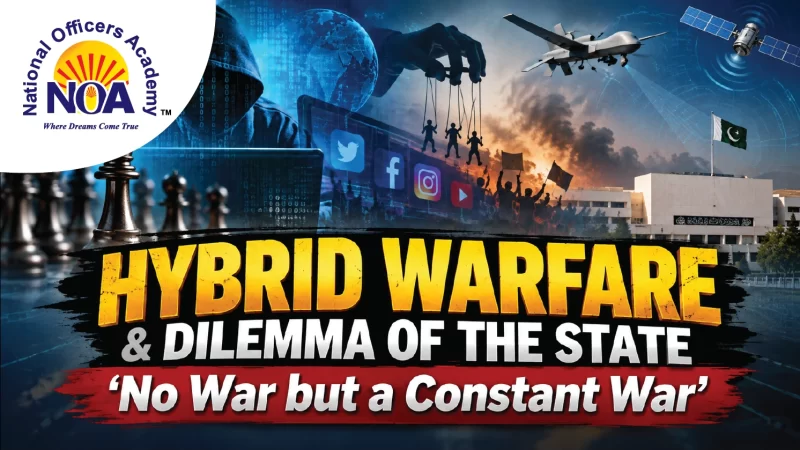
Hybrid Warfare & Dilemma of the State
“No War but a Constant War”
The nature of war has changed considerably in the post-Cold War era. In the twenty-first century, conflict is no longer limited to formally declared wars fought through conventional military means.
States and non-state actors increasingly employ a combination of military, political, economic, informational, cyber and psychological tools to achieve strategic objectives without necessarily crossing the threshold of open conventional war.
This evolving form of conflict is commonly described as hybrid warfare.
Hybrid warfare may involve:
- Military pressure
- Cyber operations
- Information warfare
- Propaganda
- Economic coercion
- Diplomatic pressure
- Proxy actors
- Terrorism
- Insurgency
- Intelligence operations
- Non-state actors
- Psychological operations
The most defining feature of hybrid warfare is ambiguity.
The boundaries between peace and war, civilian and combatant, domestic and foreign threats, and conventional and unconventional operations become increasingly blurred.
Hybrid warfare is therefore a condition in which there may be no declared war, yet the target state remains under constant strategic pressure.
Concept of Hybrid Warfare
Hybrid warfare combines multiple instruments of national and non-state power in a coordinated manner.
It attempts to exploit existing vulnerabilities within a state rather than relying solely on battlefield confrontation.
Such strategies may operate through:
- Grey-zone activities
- Non-linear warfare
- Unrestricted warfare
- Proxy warfare
- Colour revolutions
- Cyber operations
- Economic pressure
- Disinformation
The objective is often to weaken the target from within while avoiding clear attribution and direct retaliation.
Non-Linear and Non-Kinetic Warfare
Unlike traditional conflict, hybrid warfare does not necessarily follow a clear sequence of military escalation.
Political, social, economic and informational tools may be used simultaneously.
This allows an adversary to achieve strategic effects without launching a conventional invasion.
Use of Cyber Space
Cyber space has become one of the most important domains of hybrid warfare.
Cyber attacks can target:
- Government institutions
- Financial systems
- Critical infrastructure
- Military networks
- Communication systems
- Private data
Such attacks can create large-scale disruption without the physical destruction associated with traditional warfare.
Use of Non-State Actors
Hybrid strategies frequently rely on proxies, militant organisations, insurgent groups and other non-state actors.
These actors provide plausible deniability to states while enabling them to exert pressure on adversaries indirectly.
Propaganda and Information Warfare
Information warfare seeks to influence public opinion, weaken national morale and create distrust in state institutions.
It may involve:
- Disinformation
- Fake news
- Social-media manipulation
- Psychological operations
- International lobbying
- Narrative warfare
Relevance of Hybrid Warfare to Pakistan
Pakistan is highly relevant to discussions of hybrid warfare because of its geopolitical location, internal diversity, security challenges and regional rivalries.
The nuclearisation of South Asia has reduced the likelihood of unrestricted conventional conflict between major regional rivals, thereby increasing the strategic importance of indirect and asymmetric methods.
The source article argues that Pakistan has faced multiple manifestations of hybrid threats over the past two decades. :chatgpt-content-reference{index=”1″}
Security Crisis
Pakistan has faced terrorism, insurgency and internal security challenges for many years.
Several attacks on military, civilian and symbolic targets have had effects beyond immediate physical destruction.
Examples discussed in the source include:
- Attack on the Sri Lankan cricket team in Lahore
- Attack on General Headquarters
- Mehran Naval Air Base attack
- Kamra Air Base attack
- Army Public School attack in Peshawar
Such incidents affect not only security but also national morale, investment, tourism and international perception.
Political Instability as a Vulnerability
Political instability creates opportunities for hybrid threats because deeply divided societies are easier to manipulate.
When political actors, institutions and citizens lack trust in one another, external and internal actors can exploit these fault lines.
Pakistan’s political polarisation therefore represents not only a democratic challenge but also a national-security vulnerability.
Ethnic, Religious and Linguistic Fault Lines
Pakistan is an ethnically, linguistically and religiously diverse society.
Diversity itself is not a weakness, but unresolved grievances and unequal development can create vulnerabilities.
Hybrid actors may attempt to exploit:
- Ethnic grievances
- Provincial tensions
- Sectarian divisions
- Separatist sentiments
- Political exclusion
National integration and inclusive governance are therefore important components of hybrid-warfare resilience.
Balochistan and Khyber Pakhtunkhwa
Balochistan and Khyber Pakhtunkhwa occupy strategically important geographical positions and have experienced prolonged security challenges.
Violence, terrorism and identity-based grievances can create conditions in which external actors attempt to exploit domestic discontent.
The source article presents the security problems in these regions as particularly important to Pakistan’s hybrid-war environment.
Bad Governance and Lingering Social Problems
Poor governance can increase a state’s vulnerability to hybrid warfare.
Citizens facing unemployment, injustice, poverty and inadequate public services may become more susceptible to manipulation by extremist or hostile actors.
Major social vulnerabilities include:
- Economic hardship
- Unemployment
- Inequality
- Poor education
- Lack of basic services
- Weak accountability
- Law-and-order problems
Young people are particularly vulnerable when political and economic systems fail to provide meaningful opportunities.
Institutional Breakdown
Strong institutions are essential for resisting hybrid threats.
Where public institutions are inefficient, financially weak or politically contested, hostile actors can exploit institutional mistrust.
The source article highlights problems affecting public institutions and argues that tension among political, military and judicial actors can complicate effective state functioning.
Hybrid warfare becomes more effective when institutions compete instead of coordinating.
The Long War on Terror
Pakistan’s participation in the post-9/11 War on Terror placed enormous pressure on its internal security environment.
Years of terrorism produced:
- Loss of human life
- Economic damage
- Internal displacement
- Security expenditure
- Infrastructure destruction
- Reduced investment
The long-term social effects of conflict also created conditions that could be exploited by extremist groups and hostile actors.
Diplomatic Manoeuvring and International Pressure
Diplomacy can also function as a tool of hybrid competition.
States may attempt to weaken their rivals through:
- International lobbying
- Reputational pressure
- Financial restrictions
- Multilateral institutions
- Diplomatic isolation
The source discusses efforts to portray Pakistan negatively in international forums and connects such efforts with the broader concept of hybrid pressure.
FATF and Financial Pressure
Pakistan’s placement on the Financial Action Task Force grey list became a major policy and diplomatic challenge.
The experience demonstrated the importance of financial governance, anti-money-laundering measures and counter-terror-financing compliance.
Pakistan eventually implemented the required reforms and exited the grey list.
The episode highlights how financial institutions and international regulatory mechanisms can become deeply relevant to national security.
Propaganda Warfare and the EU DisinfoLab Investigation
Information warfare has become one of the most significant dimensions of contemporary strategic competition.
The source refers to the EU DisinfoLab investigation known as Indian Chronicles.
The investigation reported a large network of websites and organisations that were used to amplify narratives affecting Pakistan’s international image.
Such cases demonstrate how influence operations can operate across:
- Media
- Think tanks
- NGOs
- International organisations
- Social platforms
Information warfare can therefore have significant diplomatic and reputational consequences even without direct military action.
Cyber Warfare
Cyber threats have become increasingly important for Pakistan’s national security.
The source highlights cyber attacks affecting institutions such as the Federal Board of Revenue and National Bank of Pakistan.
Cyber operations can threaten:
- Financial security
- Government databases
- Personal information
- Critical infrastructure
- Public confidence
The development of cyber defence and data-protection systems is therefore essential.
Psychological Warfare and Perception Management
Hybrid warfare does not simply target territory or institutions. It targets how people think.
Psychological operations may attempt to:
- Reduce public confidence
- Create panic
- Deepen political divisions
- Promote ethnic hostility
- Undermine national identity
Perception management becomes especially effective in societies where citizens already distrust political and state institutions.
Implications of Hybrid Warfare for Pakistan
1. Human Cost
The most serious consequence of conflict is the loss of human life.
Pakistan’s prolonged struggle against terrorism has caused extensive civilian and security-force casualties.
2. Economic Losses
Terrorism and instability discourage investment, increase security expenditure and damage infrastructure.
Although Pakistan’s economic difficulties cannot be attributed entirely to security threats, prolonged conflict has imposed substantial economic costs.
3. International Image
Negative international narratives can harm Pakistan’s diplomatic standing and economic prospects.
A state continuously associated with instability, terrorism or extremism may face difficulties attracting investment and building international partnerships.
4. Social Polarisation
Hybrid threats can exploit regional and ethnic identities.
The source argues that when citizens increasingly identify themselves exclusively through provincial or ethnic categories rather than a shared national identity, hostile actors may exploit these divisions.
5. Institutional Distrust
Repeated information campaigns against state institutions can create long-term public mistrust.
This weakens the state’s ability to mobilise society during genuine national-security emergencies.
Assessment of Pakistan’s Response
Pakistan has introduced several measures to address terrorism, financial crime, cyber threats and extremist narratives.
Financial Intelligence and Counter-Terror Financing
Pakistan developed mechanisms aimed at strengthening financial monitoring and preventing terror financing.
Institutions and legal reforms have been used to improve compliance with international standards.
Protection of Critical National Infrastructure
The protection of critical infrastructure is an essential element of national resilience.
The source refers to a security methodology based on:
- Deter
- Detect
- Delay
- Mitigate
- Respond
This approach reflects the need for layered security against physical and non-physical threats.
De-Radicalisation Programmes
The source highlights the Sabaoon Centre for Rehabilitation and Monitoring as an example of a de-radicalisation initiative.
Such programmes aim to:
- Rehabilitate former extremists
- Provide corrective education
- Support psychological recovery
- Facilitate social reintegration
Military Operations Against Extremist Groups
Pakistan has conducted multiple security operations against militant organisations.
These operations helped reduce the operational capacity of extremist groups in several areas.
However, military action alone cannot eliminate ideological, political and socioeconomic drivers of militancy.
National Security Dialogue and National Security Policy
Pakistan has increasingly attempted to broaden the concept of national security beyond traditional military threats.
National-security policy discussions now include:
- Economic security
- Cyber security
- Human security
- Information security
- Climate risks
This broader approach is important because hybrid warfare operates across multiple dimensions simultaneously.
Weaknesses in Pakistan’s Response
Despite important measures, Pakistan’s response remains constrained by several weaknesses.
1. Lack of a Coherent National Policy
Hybrid threats require a whole-of-state strategy.
Separate institutions working independently cannot effectively counter coordinated political, economic, cyber and informational threats.
2. Weak Institutional Coordination
Intelligence, law enforcement, economic regulators, media authorities and civilian institutions need stronger coordination.
3. Limited Cyber Capacity
Pakistan requires greater investment in:
- Cyber defence
- Data security
- Artificial intelligence
- Digital forensics
- Critical infrastructure protection
4. Weak Strategic Communication
Pakistan often responds defensively to international narratives rather than proactively shaping them.
Strategic communication and public diplomacy therefore need improvement.
5. Domestic Political Polarisation
Internal political conflict itself creates vulnerabilities that hybrid actors can exploit.
A divided society makes national consensus on security issues much more difficult.
Suggestive Measures to Counter Hybrid Warfare
1. Develop a Comprehensive Hybrid Warfare Doctrine
Pakistan needs a clear national framework that defines hybrid threats and allocates institutional responsibilities.
The strategy should integrate:
- Military security
- Cyber security
- Economic security
- Diplomatic security
- Information security
- Social resilience
2. Strengthen Security Institutions
Law-enforcement and security agencies require modern training and technology.
Simulation-based training and advanced digital systems can improve preparedness for complex threats.
3. Build Cyber Resilience
Pakistan should strengthen national cyber-security architecture through:
- Cyber-security centres
- Incident-response teams
- Data-protection systems
- Digital forensics
- Critical infrastructure audits
4. Strengthen Counter-Terror Financing
Financial-monitoring mechanisms should remain strong even after Pakistan’s exit from the FATF grey list.
Terror financing, money laundering and illicit financial networks remain important national-security threats.
5. Build Social Inclusion
Inclusive state policies can reduce opportunities for hostile actors to exploit social grievances.
Priority should be given to:
- Education
- Employment
- Provincial inclusion
- Minority rights
- Social justice
6. Expand De-Radicalisation Programmes
Successful rehabilitation models should be adapted for regions affected by militancy and extremism.
7. Strengthen Strategic Communication
Pakistan needs professional mechanisms to counter disinformation and communicate its position internationally.
This requires:
- Fact-based communication
- Digital diplomacy
- International media engagement
- Think-tank diplomacy
- Academic outreach
8. Promote Media Literacy
Citizens should be trained to recognise misinformation, manipulated content and hostile narratives.
Media literacy can significantly reduce the effectiveness of propaganda.
9. Strengthen National Integration
A cohesive society is far more resistant to hybrid threats.
Pakistan should promote equal citizenship, constitutionalism, provincial inclusion and fair resource distribution.
10. Improve Governance
Good governance is one of the strongest defences against hybrid warfare.
When citizens trust the state, external manipulation becomes more difficult.
Conclusion
Hybrid warfare has transformed the nature of modern conflict.
States no longer need to invade territory directly to weaken an adversary.
Cyber attacks, propaganda, proxies, terrorism, diplomatic pressure, economic coercion and information manipulation can achieve significant strategic effects without a formally declared war.
Pakistan’s experience over the past two decades demonstrates how multiple instruments of pressure can operate simultaneously across security, political, economic and social domains.
The country’s greatest vulnerability lies not only in external threats but also in internal weaknesses such as political instability, poor governance, institutional distrust, social inequality and cyber insecurity.
Pakistan has adopted important measures in counter-terrorism, financial monitoring, institutional protection and de-radicalisation, but a more coherent whole-of-state approach is still required.
In the age of hybrid warfare, national resilience depends as much on strong institutions, economic stability, social cohesion and information security as it does on conventional military power.