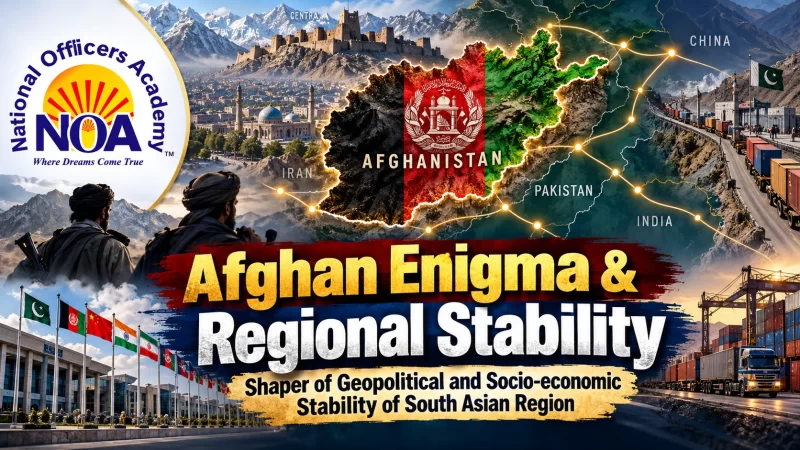
Afghan Enigma & Regional Stability
Shaper of Geopolitical and Socio-Economic Stability of South Asian Region
The Taliban returned to power in Afghanistan in 2021, twenty years after being removed by the US-led intervention that followed the September 11 attacks.
As the United States withdrew its remaining forces under the framework created by the 2020 agreement with the Taliban in Qatar, the Taliban rapidly expanded territorial control and entered Kabul in August 2021.
The speed of the takeover fundamentally altered Afghanistan’s political order.
After taking control of Kabul, the Taliban announced an interim government dominated by senior members of the movement and rejected the previous constitutional and political framework.
The return of the Taliban created a new dilemma for the international community: whether and under what conditions the new Afghan government should receive diplomatic recognition.
Afghanistan’s importance extends far beyond its borders. Located at the intersection of South Asia, Central Asia, the Middle East and China, it occupies one of the most strategically important geographical positions in Asia.
The security and prosperity of Afghanistan are closely connected with the peace, stability and economic integration of the wider region.
Afghanistan: A Troubled History
Afghanistan has historically been exposed to intervention, invasion and competition among external powers.
Its location at the crossroads of major regions has made it strategically valuable but has also contributed to repeated conflict.
During the Cold War, Afghanistan became a major theatre of rivalry following the Soviet intervention in 1979.
The conflict was followed by:
- Civil war
- The rise of the Taliban
- The Taliban takeover in 1996
- The emergence of Al-Qaeda sanctuaries
- The US-led intervention after 9/11
- Two decades of war
These prolonged conflicts damaged Afghanistan’s infrastructure, institutions, economy and social development.
The Taliban and the Post-2001 Conflict
The Taliban government established in the 1990s faced growing international criticism because of its domestic policies and relationship with Al-Qaeda.
The September 11 attacks became a decisive turning point.
The United States intervened militarily in Afghanistan with the objective of dismantling Al-Qaeda and removing the Taliban government that had provided sanctuary to the organisation.
Although the Taliban government was quickly overthrown, the movement regrouped and fought a prolonged insurgency.
The source highlights a major strategic contrast:
- The Taliban relied heavily on guerrilla and asymmetric warfare.
- The United States and its allies relied predominantly on conventional military superiority.
The Taliban possessed important advantages in local geography, social networks and knowledge of the operating environment.
The eventual withdrawal of foreign forces and rapid collapse of the former Afghan government demonstrated the limits of military power without durable political legitimacy.
Humanitarian Crisis in Afghanistan
The Taliban takeover coincided with a severe humanitarian and economic crisis.
In January 2022, the United Nations launched what the source describes as its largest single-country humanitarian appeal at the time for Afghanistan.
By March 2022, the source notes that approximately 95 percent of Afghan households were experiencing inadequate food consumption, while millions of children required nutritional assistance.
By August 2022, millions of Afghans were described as being on the brink of famine.
Major Drivers of the Humanitarian Crisis
- Economic collapse
- Loss of foreign development assistance
- International sanctions
- Restrictions affecting financial transactions
- Food insecurity
- Climate-related disasters
- Rising global food prices
- Effects of the Russia-Ukraine war
Heatwaves, floods and other climatic shocks further damaged crops and agricultural land.
The humanitarian crisis therefore became a combination of political isolation, economic contraction and environmental vulnerability.
Afghanistan and the Geopolitical Stability of South Asia
Afghanistan’s political and security situation has direct consequences for South Asia and neighbouring regions.
1. Afghanistan as the Heart of Asia
Historically, Afghanistan served as a crossroads linking major civilisations and trading regions.
Even today, its geography provides potential connectivity between:
- South Asia
- Central Asia
- China
- Iran
- The Middle East
This makes Afghanistan important both for regional geopolitics and economic integration.
A peaceful Afghanistan could facilitate trade and transit, while an unstable Afghanistan can disrupt connectivity and spread insecurity across neighbouring states.
2. Regional Security
Afghanistan lies close to several strategically important states, including Pakistan, Iran, China and the Central Asian republics.
Its stability therefore affects multiple national-security calculations.
For Pakistan, Afghanistan is directly relevant to:
- Border security
- Terrorism
- Refugee flows
- Trade
- Regional connectivity
For China, developments in Afghanistan are linked partly with concerns about security in Xinjiang and the protection of regional economic projects.
For Iran, Afghanistan matters because of border security, refugees, narcotics, trade and the presence of ethnic and religious communities with cross-border links.
Russia and Central Asian states are similarly concerned about militancy, drug trafficking and instability spreading northward.
Impact on Regional Bilateral Relations
Afghanistan has repeatedly been viewed as a potential regional trade and transit hub.
Several major initiatives have sought to utilise its geographical position.
Major Regional Connectivity Projects
- CASA-1000: Electricity connectivity between Central Asia and South Asia
- TAPI Pipeline: Turkmenistan-Afghanistan-Pakistan-India gas pipeline
- Trans-Afghan Railway: Proposed rail connectivity from Central Asia to Pakistani ports
- Lapis Lazuli Corridor: Connectivity from Afghanistan towards Türkiye and Europe
- Belt and Road Initiative: Potential integration of Afghanistan into wider Chinese connectivity projects
Afghanistan’s participation in these projects could create new trade routes, improve energy access and strengthen regional interdependence.
However, security instability and diplomatic isolation continue to limit their potential.
Regional Forums and Afghanistan
Regional cooperation concerning Afghanistan has involved several diplomatic mechanisms.
These include:
- Shanghai Cooperation Organisation-Afghanistan Contact Group
- Heart of Asia-Istanbul Process
- Regional Economic Cooperation Conference on Afghanistan
Such forums demonstrate that Afghanistan’s problems cannot be resolved by one state acting alone.
Regional participation is essential for a durable settlement.
Drug Trafficking
Afghanistan has historically been a major producer of opium used in heroin production.
The narcotics trade has serious implications for neighbouring countries.
States affected include:
- Pakistan
- Iran
- Tajikistan
- Russia
Drug trafficking contributes to:
- Organised crime
- Border violence
- Addiction
- Illicit financing
- Corruption
The source notes that although the Taliban announced restrictions on opium cultivation, questions remained regarding the durability and enforcement of these policies.
Resurgence of the Security Dilemma
The withdrawal of American and allied forces and the Taliban’s return created a new security environment.
One of the principal concerns is the continued presence of militant and terrorist organisations inside Afghanistan.
The source identifies groups such as:
- Tehreek-e-Taliban Pakistan
- Al-Qaeda
- Islamic State Khorasan Province
- East Turkestan Islamic Movement
- Islamic Movement of Uzbekistan
Different organisations create different threats for neighbouring states.
Afghanistan therefore remains central to regional counter-terrorism concerns.
Taliban Rule and the Revival of Terrorism Concerns
The Taliban have maintained effective territorial control across much of Afghanistan, but concerns remain regarding political inclusion and militant organisations operating in the country.
The source argues that non-Pashtun ethnic groups have remained underrepresented in meaningful political power.
This creates concerns regarding future political alienation and instability.
At the same time, neighbouring states expect the Taliban government to prevent Afghan territory from being used against them.
Girls’ Education and Women’s Rights
The Taliban’s restrictions on girls’ education and women’s participation in society have generated widespread international criticism.
Regional states may differ from Western powers regarding the priority attached to these issues, but the restrictions have nevertheless complicated Afghanistan’s diplomatic engagement.
Regional governments have also called for:
- Greater political inclusion
- Educational access
- Stability
- Responsible governance
Socio-Economic Impact on South Asia
Afghanistan’s instability affects South Asia beyond conventional security concerns.
1. Refugee Inflows
Decades of conflict have displaced millions of Afghans.
Pakistan has hosted large Afghan refugee populations for decades.
Large and prolonged refugee flows place pressure on:
- Housing
- Employment
- Education
- Healthcare
- Public services
2. Brain Drain
Political uncertainty and economic hardship encourage skilled Afghans to leave the country.
The loss of educated professionals makes institutional reconstruction and economic development more difficult.
3. Energy Access
A stable Afghanistan could facilitate major energy projects linking Central and South Asia.
Projects such as CASA-1000 and TAPI depend heavily on a secure Afghan transit environment.
4. Trade and Transit
Afghanistan could provide landlocked Central Asian states with access to Pakistani ports while enabling Pakistan to expand trade with Central Asia.
This gives Afghanistan significant geo-economic importance.
5. Impact on BRI and CPEC
Improved stability in Afghanistan could create opportunities for wider regional connectivity involving the Belt and Road Initiative and CPEC.
Conversely, terrorism and instability can threaten investments, transport routes and regional economic integration.
Pakistan’s Role in Bringing Stability to Afghanistan
Pakistan is one of the states most directly affected by instability in Afghanistan.
It therefore has a strong interest in the emergence of a peaceful, stable and economically viable neighbouring state.
Immediately after the Taliban takeover, Pakistan urged the international community to provide humanitarian assistance and avoid measures that could cause complete economic collapse.
However, increasing cross-border terrorism and tensions gradually produced a more cautious Pakistani approach.
Cross-Border Terrorism and TTP
One of Pakistan’s principal concerns is the presence of the Tehreek-e-Taliban Pakistan in Afghanistan.
The source notes a significant rise in terrorist attacks in Pakistan following the Taliban takeover.
Islamabad has repeatedly called upon Afghan authorities to prevent Afghan territory from being used by groups targeting Pakistan.
Border Security
Incidents along the Pakistan-Afghanistan border have further complicated bilateral relations.
Border management therefore remains one of the most important areas requiring institutional cooperation.
How Pakistan Can Contribute to Stability
1. Promote an Inclusive Afghan Political System
Pakistan should encourage the Afghan authorities to create a more representative political framework.
Greater inclusion of ethnic and political groups could reduce the risk of future internal conflict.
2. Support Humanitarian Assistance
Afghan civilians should not bear the full cost of diplomatic disagreements with the Taliban government.
Pakistan can support international humanitarian engagement while advocating mechanisms that ensure assistance reaches vulnerable populations.
3. Strengthen Border Management
Pakistan and Afghanistan need greater government-to-government coordination on:
- Border crossings
- Customs
- Security
- Refugee movement
- Counter-smuggling operations
4. Expand Trade Assistance
Greater bilateral trade can strengthen economic interdependence and provide Afghanistan with legal alternatives to illicit economic networks.
Pakistan can facilitate:
- Transit trade
- Port access
- Transport connectivity
- Formal banking and commercial links
5. Use Regional Organisations
Pakistan can use multilateral forums to promote regional consensus on Afghanistan.
Potential platforms include:
- Organisation of Islamic Cooperation
- Shanghai Cooperation Organisation
- SAARC-related regional dialogue
- Heart of Asia Process
6. Promote CPEC and Wider Connectivity
Where security and political conditions permit, Afghanistan’s participation in regional infrastructure and connectivity initiatives could provide incentives for stability.
Economic integration can create mutual dependence that raises the cost of conflict.
7. Promote Track-II and Track-III Diplomacy
Official diplomacy should be supplemented by engagement among:
- Academics
- Business communities
- Religious scholars
- Civil society
- Local communities
Such engagement can improve communication and reduce mistrust between neighbouring societies.
Pakistan-Afghanistan Relations: From Optimism to Caution
Pakistan initially viewed the change of government in Kabul with expectations that the new authorities would address anti-Pakistan militant groups.
However, subsequent developments created frustration in Islamabad.
The presence of TTP elements, attacks inside Pakistan and border incidents have demonstrated that a Taliban-controlled Afghanistan does not automatically guarantee improved Pakistan-Afghanistan relations.
The relationship therefore requires realistic diplomacy rather than expectations based solely on ideological or historical assumptions.
Way Forward for Regional Stability
1. Prevent Afghanistan from Becoming a Terrorist Sanctuary
The Afghan authorities must prevent transnational militant organisations from operating against neighbouring countries.
2. Encourage Political Inclusion
A broader political arrangement can reduce ethnic grievances and lower the risk of internal insurgency.
3. Restore Economic Connectivity
Regional trade and transit should become central elements of Afghanistan’s economic recovery.
4. Support Humanitarian Relief Without Politicising Aid
Humanitarian assistance should address civilian needs while maintaining appropriate accountability mechanisms.
5. Coordinate Regional Diplomacy
Pakistan, China, Iran, Central Asian states, Russia and other stakeholders need coordinated approaches rather than competing interventions.
6. Improve Pakistan-India Cooperation Where Possible
Pakistan and India have competing interests in Afghanistan, but continued rivalry can complicate Afghan stability.
Regional stability would benefit if competition were replaced, where possible, by support for trade, development and non-interference.
Conclusion
Afghanistan’s geostrategic position has been both a source of opportunity and a cause of repeated conflict.
Its location at the heart of Asia gives it the potential to connect South Asia, Central Asia, China and the Middle East through trade, energy and transport corridors.
At the same time, prolonged instability has allowed terrorism, narcotics trafficking, refugee flows, political rivalry and humanitarian crises to affect the wider region.
The Taliban’s return to power has therefore created both opportunities and serious challenges.
A stable Afghanistan could facilitate regional connectivity, economic integration and energy cooperation. An unstable Afghanistan, however, risks becoming a source of militancy, displacement and geopolitical competition.
Pakistan has a particularly important role because it shares a long border, deep historical ties and significant security and economic interests with Afghanistan.
Islamabad should combine humanitarian engagement, border management, regional diplomacy, economic connectivity and firm demands against cross-border terrorism.
Ultimately, Afghanistan’s future will significantly shape the peace, security and prosperity of South Asia. Regional stability therefore depends not on isolating Afghanistan, but on integrating it into a cooperative political, security and economic framework.