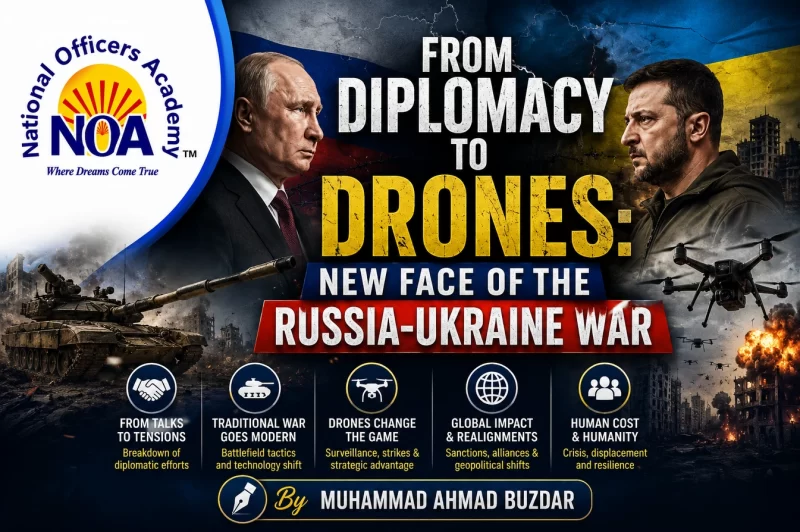
From Diplomacy to Drones
New Face of the Russia-Ukraine War
Written By: Muhammad Ahmad Buzdar
Introduction: A War Without End
Now entering its fourth year, the Russia-Ukraine war remains one of the most volatile conflicts in modern history. Despite promises from global leaders, including U.S. President Donald Trump, to bring an end to the bloodshed, the war has intensified.
The battlefield is no longer confined to territorial skirmishes. It has evolved into a complex arena of drone warfare, psychological operations, and failed diplomatic efforts, particularly the recent peace talks in Istanbul.
Since returning to office in 2025, Donald Trump, often described as the master of superlatives, has repeatedly claimed that he would end the Russia-Ukraine war swiftly, sometimes promising results within 24 hours.
Yet these assurances have failed to materialize into concrete outcomes. His administration’s approach has swung between tough talk and public concessions to Russia, including ruling out Ukraine’s NATO membership and diminishing U.S. military aid.
These shifts have sparked criticism from allies, outrage among some Republican senators, and disillusionment in Ukraine.
The Summer Escalation: War Reignites
As the summer fighting season of 2025 commenced, Russia dramatically escalated its offensive. The Kremlin shifted its primary focus to destabilizing Ukraine through targeted strikes on the eastern front, aiming to encircle Ukrainian forces and sever supply routes.
Ukraine, in turn, held its ground more effectively than in previous years. Though unable to fully repel Russian forces, Kyiv demonstrated improved defensive strength and flexibility in strategy.
Meanwhile, Russia’s aerial campaign intensified with nightly missile and drone strikes across Ukraine, exposing the limitations of Kyiv’s air defense systems, particularly the shortage of U.S.-made Patriot batteries.
The on-ground stalemate has not diminished the war’s intensity. Rather, it has entrenched both sides deeper into conflict.
Operation Spiderweb: Ukraine’s Tactical Masterstroke
On June 1, 2025, Ukraine stunned the world with Operation Spiderweb, a sophisticated and long-planned drone strike on five Russian airbases deep within Russian territory.
The operation, using 117 FPV drones, destroyed or disabled 41 high-value military aircraft, including strategic bombers and A-50 surveillance planes.
Launched from within Russia using disguised civilian trucks, the operation highlighted Ukraine’s innovative military capabilities.
This bold maneuver was more than just a tactical victory. It was a psychological blow to the Kremlin and a strategic signal to the world.
It showed Ukraine’s ability to strike with precision deep behind enemy lines without direct NATO involvement. The operation elevated Ukraine’s standing in the war, transforming it from a reactive defender into an assertive military actor.
Strategic Repercussions and Symbolism
Operation Spiderweb shattered the assumption that Russia’s heartland was beyond reach. It forced Moscow to stretch its defenses across vast regions rather than focusing troops near Ukraine.
The symbolic message was clear: no part of Russia is safe from retaliation.
By executing this operation independently and with commercial satellite data, Ukraine emphasized both its technological resourcefulness and strategic independence.
Internationally, the operation reshaped perceptions. Western allies are now reassessing Ukraine’s potential, with increased interest in funding advanced drone capabilities.
Domestically, Russia faces pressure over its vulnerability, as calls for harsher retaliation, including from nuclear hawks, continue to gain traction.
NATO’s Role and the Drone Revolution
With the United States halting new aid, NATO allies have stepped in.
A new €20 billion military package has been announced, with Germany sending long-range bombs, the United Kingdom supplying 100,000 drones, and the Netherlands contributing 100 naval vessels and drones. Norway has also pledged $700 million in drone support.
This marks a strategic shift. Ukraine is no longer dependent solely on traditional military support.
Drone warfare has enabled Ukraine to offset Russian numerical superiority and maintain initiative on the battlefield.
The Istanbul Peace Talks: A Glimmer of Hope?
In May and June 2025, delegations from Ukraine and Russia convened in Istanbul for the first direct negotiations in years.
Hopes were high, but they were quickly weakened by President Vladimir Putin’s absence. While President Volodymyr Zelensky attended in good faith, Putin’s decision to stay away reduced the talks’ potential.
Despite this, the talks yielded the largest prisoner exchange to date, with 1,000 soldiers from each side being exchanged. This marked a significant confidence-building measure.
However, proposals for a 30-day unconditional ceasefire, advocated by Ukraine and supported by the United States, were rejected by Russia.
Instead, Moscow presented a memorandum outlining extensive demands, including Ukrainian withdrawal from annexed regions and a ban on foreign military presence.
Diplomacy’s Fragile Foundations
The peace talks revealed fundamental flaws in the diplomatic process. Current negotiation frameworks treat the war as a transactional issue, focused mainly on concessions and adjustments.
However, this approach overlooks the human toll of war, including trauma, justice, and societal recovery.
A durable peace requires more than military de-escalation. It demands acknowledgment of suffering, commitment to transitional justice, and a broader conversation on accountability.
Without these elements, any ceasefire risks being fragile and short-lived.
True diplomacy must address not only security arrangements but also emotional and psychological wounds.
The Geopolitical Shift in Europe
Europe has been deeply affected by the conflict. Russia’s invasion and America’s wavering support have catalyzed a shift toward strategic autonomy.
German Chancellor Friedrich Merz has called for Europe to achieve independence from the United States and has spearheaded increased defense spending.
While the European Union’s collective defense spending has risen to €326 billion, around 1.9% of GDP, it still lags far behind the United States.
There are active discussions about deepening integration, expanding defense industries, and developing a more coherent foreign policy.
However, internal divisions and differing national interests continue to pose challenges to European unity.
The Frozen Assets Question
Europe currently holds about two-thirds of Russia’s $300 billion in frozen assets.
With EU sanctions up for renewal every six months, unanimity is required to keep these assets locked.
If released, these assets could reinvigorate Russia’s war machine.
If seized and transferred to Ukraine, they could fund critical reconstruction efforts and serve both as compensation and leverage.
The frozen assets question has therefore become a major legal, financial, and strategic issue in the wider war.
Hurdles in the Way of Trump’s Peace Plan
Trump could not implement his peace plan because he failed to get the support of Ukraine and European allies, who strongly opposed it.
Even the deeper state in the United States that deals with foreign policy probably resisted its implementation.
Accepting Putin’s demands would mean three major concessions:
- The captured territories would not be returned.
- Ukraine would not become part of the NATO alliance and would remain neutral.
- Ukraine would mainly demilitarize and maintain minimum possible deterrence.
Such concessions would simply mean an ugly victory for Russia, which would never be acceptable to the ruling elite in the West.
The recent increase in defense spending by NATO members from 1.9% to 5% of their GDP sends two clear messages.
First, the implementation of Trump’s plan in the near future seems unlikely.
Second, the Kremlin has received the message that the alliance will not back out from supporting Ukraine.
As a result, Russia may have to continue fighting this costly war.
Conclusion: Innovation, Resolve, and the Road Ahead
Operation Spiderweb marks a turning point in the Russia-Ukraine war. It reflects Ukraine’s evolution from a reactive actor into a strategic force.
The war has entered a new phase where resourcefulness can rival brute force, and diplomacy must evolve to reflect the emotional and human depth of the conflict.
The Russia-Ukraine war now stands as a global litmus test for justice, resilience, and the future of warfare and peacebuilding in the twenty-first century.
As the world watches, what comes next will not only define Ukraine’s sovereignty but also reshape the international order itself.