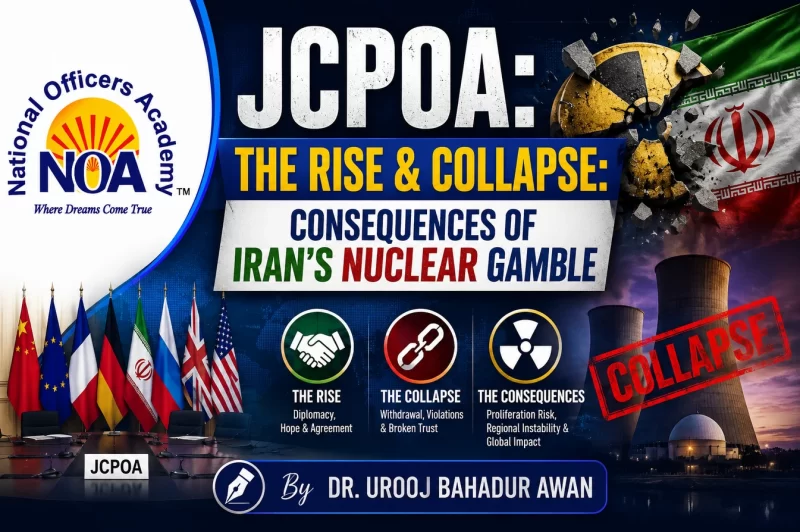
JCPOA: The Rise & Collapse
Consequences of Iran’s Nuclear Gamble
Written By: Dr. Urooj Bahadur Awan
An Analytical Review of Diplomacy, Power Politics, and Regional Fallout
Following the gradual erosion of JCPOA commitments and post-2018 escalation, Iran appears to be on a path toward nuclearization, having both the technical capability and strategic intent to become a nuclear state. Despite the initial constraints imposed by the deal, recent developments indicate a rapid acceleration in Iran’s nuclear capabilities.
The JCPOA was formulated to limit Iran’s capacity to produce nuclear weapons. It aimed to do so by imposing restrictions on uranium enrichment, capping stockpiles, and modifying heavy-water reactors. The International Atomic Energy Agency (IAEA), a regulatory body under the JCPOA framework, was tasked with continuous monitoring to verify compliance.
However, after Donald Trump’s unilateral withdrawal from the JCPOA agreement, Iran significantly expanded its enriched uranium stockpiles. Enrichment levels reaching 60% uranium-235 have effectively reduced Iran’s breakout time from years to months, and possibly weeks. Simultaneously, the deployment of advanced centrifuges has increased enrichment efficiency, further alarming observers about Iran’s long-term nuclear intentions.
The narrative built by Iran’s political and religious elites — that nuclearization is essential to overcoming the nation’s existential crisis — has increasingly gained public acceptance. This notion has been further normalized in the aftermath of Israeli and U.S. attacks, transforming what was once a strategic discourse into a mainstream national sentiment.
The Interplay of Pressure and Pragmatism in the Formation of the JCPOA
By the early 2010s, Iran found itself surrounded by severe economic, political, and diplomatic pressures that reshaped its strategic path. Years of crippling international sanctions, particularly those targeting Iran’s oil exports and banking sector, had pushed the economy into deep recession.
Externally, Iran faced growing regional isolation, with Gulf States and Israel lobbying Washington to adopt a tougher stance, while the European Union tightened multilateral sanctions through the UN framework.
Eventually, President Hassan Rouhani’s government adopted a pragmatic approach by negotiating under the Obama administration’s dual-track policy of sanctions and engagement. Economic strain, diplomatic isolation, and internal fatigue forced Tehran to enter the 2013 negotiations, which later led to the formation of the Joint Comprehensive Plan of Action (JCPOA). The deal was largely shaped by both external and internal pressures on Iran.
Obama’s Historic Diplomatic Achievement
“This deal demonstrates that American diplomacy can bring about real and meaningful change, a change that makes our country and the world safer.” — Barack Obama
For President Barack Obama, the JCPOA was more than a nuclear agreement. He considered it a major diplomatic milestone that could contribute to peace in the Middle East. He hailed it as a historic success of negotiation over confrontation, claiming that it “cut off every path to a bomb.”
Obama continues to defend the agreement to this day. He maintains that the deal was the best available option to prevent Iran from obtaining a nuclear weapon through diplomacy, without resorting to war.
The JCPOA became a turning point in Middle Eastern dynamics. It reinforced non-proliferation norms and created a possible trajectory toward regional stability through diplomacy and alliance-building. The deal also symbolized a thaw between Washington and Tehran, marking the first significant diplomatic engagement since the 1979 Iranian Revolution.
A Fragile Triumph of Diplomacy: Non-Compliance Under the JCPOA
The West believes that Iran has gradually encroached upon its commitments under the JCPOA. The EU and the E3 have expressed serious concerns about these Iranian breaches and have called on Iran to reverse them, while stopping short of taking strong punitive action.
Iran’s major nuclear facilities include:
- Fordow: Fuel enrichment plant near Qom
- Natanz: Uranium enrichment complex
- Esfahan: Uranium conversion and fuel fabrication facility
- Arak: Heavy-water reactor
- Bushehr: Commercial nuclear power plant
According to Israel’s intelligence assessment, Iran’s breakout time for accumulating sufficient military-grade fissile material for a bomb has shrunk to around four months, nearing the levels reached before the JCPOA. In addition, Iran would require approximately 21 to 24 months to construct a nuclear weapon in parallel with enrichment, assuming there is no active weaponization program.
Trump’s Strategic Reversal: From Diplomacy to Maximum Pressure
In 2018, President Donald Trump withdrew from the JCPOA, branding it the “worst deal ever negotiated.” He argued that the deal merely delayed, rather than prevented, Iran’s ability to acquire nuclear weapons.
Trump denounced the JCPOA as a “one-sided transaction” that, in his view, offered the United States little strategic gain. He argued that the agreement lifted critical economic sanctions on Iran in exchange for only temporary and weak restrictions on its nuclear program.
He also claimed that the deal paved the way for Iran’s “sinister regional activities” in Yemen, Syria, and the wider Middle East. Trump described the agreement as an embarrassment and a historic strategic blunder, asserting that it neither dismantled Iran’s enrichment capabilities nor permanently blocked its pathway to weaponization.
The Trump administration also criticized the sunset clauses and the exclusion of Iran’s ballistic missile program from the agreement.
Trump introduced a “maximum pressure campaign” that imposed crippling sanctions on Iran in an attempt to force Tehran into negotiating a “better deal.” However, the move backfired by fueling mistrust between Iran and the United States. It further led to Iran’s expansion of nuclear activities.
Trump’s Policy and Netanyahu’s Opposition to the JCPOA
Israeli Prime Minister Benjamin Netanyahu emerged as one of the JCPOA’s fiercest critics because he wanted to see Iran regionally and globally isolated.
His 2012 UN speech, complete with a cartoon bomb diagram, symbolized Israel’s deep anxiety over Iran’s enrichment program. He used the visual aid to illustrate Iran’s progress in enriching uranium and argued that a “clear red line” needed to be established by the international community to prevent Iran from reaching the point of creating a nuclear weapon.
Netanyahu claimed that Iran was “months away” from completing the second stage of enrichment and would soon have enough enriched uranium for a first bomb. He stated that drawing a clear red line would prevent war rather than cause it.
Not only that, Netanyahu also persistently lobbied U.S. lawmakers, arguing that the JCPOA was a pathway, not a barrier, to nuclear capability. His address to the U.S. Congress in 2015, delivered without presidential approval, highlighted the intensity of Israeli opposition.
This opposition contributed to Trump’s withdrawal from the agreement. Following Trump’s withdrawal, Netanyahu celebrated it as a “historic move,” even though it offered no viable alternative beyond continued sanctions and potential military escalation.
USA and Israel Against Iran: The War
The unravelling of the JCPOA intensified the conflict between Iran and Israel. Israel attacked Iran on 1 April, while Iran retaliated on 13 April 2024. Iran’s nuclear sites at Natanz and Fordow became targets of recurring strikes.
Israel’s attack killed 610 people and injured 4,746. The full-scale attacks were launched by Israel through aerial strikes using F-35 and F-15 fighter jets. These strikes damaged nuclear sites, missile installations, oil and gas fields, and targeted high-profile scientists and military leadership.
The conflict also spilled into Syria, Lebanon, and the Red Sea, where Israel targeted Iranian-backed proxies. Threats to close the Strait of Hormuz and the targeting of oil tankers further destabilized global energy markets, highlighting the ripple effects of a collapsed nuclear accord.
Similarly, the U.S.–Iran war marked the most intense escalation between Washington and Tehran since the 1979 Revolution, reshaping the strategic landscape of the Middle East. The conflict rapidly expanded, targeting Iran’s key military, oil, and communication infrastructure, while Iran responded through asymmetric warfare via its regional allies in Iraq, Lebanon, and Yemen.
Despite its brief duration, the war inflicted severe economic and humanitarian damage on Iran, disrupted global oil supply chains, and destabilized regional security frameworks. Diplomatically, it deepened Iran’s isolation, weakened the clerical establishment’s legitimacy, and forced a recalibration of its foreign policy priorities.
For the United States, the war reaffirmed military dominance but raised questions about the sustainability of deterrence-based policies and the erosion of diplomatic alternatives after the collapse of the JCPOA.
Regional and Global Repercussions: The Middle East on Edge
The regional and global repercussions of Iran’s nuclearization are multifaceted, with far-reaching consequences for the economic, political, demographic, and geostrategic landscape of the Middle East.
Iran’s decision will reshape multiple dimensions of regional stability and power dynamics.
Future Implications if Iran Proceeds with Nuclearization
Iran’s Deterrence and the Risk of an Arms Race
Iran’s progress toward nuclearization would mainly be driven by deterrence. Iran’s nuclear capability would hinder the United States and Israel from attacking Iran directly. This would strengthen Iran’s sense of security and regime survival.
However, the same move would also create major instability in the Middle East. Israel would feel directly threatened, increasing the chances of a pre-emptive strike. At the same time, GCC states such as Saudi Arabia and the UAE would fear Iran’s growing power, pushing them into a faster nuclear or advanced-weapons race. This would weaken the already fragile regional balance.
Increased Threat from the United States and Israel
Another major consequence of Iran’s nuclear advancement is the possibility of future U.S. and Israeli attacks. Both countries have already demonstrated through strikes on Natanz, Fordow, and other nuclear sites that they will not tolerate Iran reaching weapons capability.
These attacks send a clear warning that Iran’s nuclear progress will be met with military action. This constant threat increases the risk of repeated strikes, which could escalate into wider conflict if Iran retaliates through its regional proxies in Lebanon, Iraq, Yemen, or Syria.
Altered Energy Politics
Iran’s nuclear choices will also affect its role in global energy politics. If Iran accelerates nuclearization, the West will likely impose harsher sanctions, limit Iran’s oil exports, and worsen its economic conditions.
However, if Iran returns to diplomacy, it may secure selective sanctions relief and limited access to oil markets. Iran’s strategic control over the Strait of Hormuz will remain a major source of leverage, but whether it uses this leverage for confrontation or negotiation will shape both regional security and global energy flows.
Possibilities for Iran–U.S. Negotiations and Their Impact
Despite tensions, negotiations between Iran and the United States remain possible. Multiple rounds of indirect U.S.–Iran talks took place in spring 2025.
However, any new negotiation under a Trump-led administration would require broader commitments from Iran. The United States would likely go beyond simple nuclear limits and demand restrictions covering missile programs, cyber and covert operations, and Iran’s support for regional proxies, including Hezbollah, the Houthis, and Iraqi militias.
Consequences if Iran Rejects Future Deals
If Iran completely backs out of any future diplomatic framework, the regional balance will shift sharply. Iran’s withdrawal from negotiations would give Saudi Arabia and its allies more freedom to strengthen their influence in Yemen, Syria, and Lebanon — regions where Iran currently has significant political and military leverage.
This would deepen rivalry between Iran and Saudi Arabia, intensify sectarian divides, and further fragment the political landscape of the Middle East.
Iran’s nuclear choices will also affect its role in global energy politics. If Iran accelerates nuclearization, the West will likely impose harsher sanctions, limit Iran’s oil exports, and worsen its economic conditions.
However, if Iran returns to diplomacy, it may secure selective sanctions relief and limited access to oil markets. Iran’s strategic control over the Strait of Hormuz will remain a major source of leverage, but whether it uses this leverage for confrontation or negotiation will shape both regional security and global energy flows.
Energy Geopolitics and the Strait of Hormuz
The Strait of Hormuz, a narrow chokepoint through which nearly 20% of the world’s oil flows, has become a flashpoint of strategic tension. Each escalation between Iran and the West has triggered spikes in global oil prices.
Post-JCPOA sanctions crippled Iran’s oil exports, shrinking its economy by over 6% in 2019. Yet, Iran’s leverage lies precisely in this geography. Its ability to threaten maritime routes remains one of its most potent deterrence tools.
The energy geopolitics surrounding the JCPOA has therefore surpassed the nuclear issue, intertwining economic politics with global oil trade.
Iran’s Nuclear Policy Crossroads: Nuclearization to Fight the Existential Threat
For decades, Tehran maintained that it does not seek nuclear weapons, emphasizing a religious belief or fatwa by Supreme Leader Ayatollah Khamenei.
However, after the U.S. withdrawal and repeated Israeli strikes, Iran’s nuclear policy appears to have shifted from restraint to strategic hedging. By enriching uranium beyond 60% purity and developing advanced centrifuges, Iran is getting closer to attaining nuclear capability.
This transformation highlights a growing consensus among powerful Iranian circles that nuclear capability ensures regime survival amid external hostility.
Iran’s escalation would almost certainly coincide with greater proxy activity involving Hezbollah, the Houthis, and Iraqi militias. This could provoke Israeli or U.S. counter-responses, leading to broader strikes inside Iran itself.
Iran’s Economic Crossroads: Strategic Engagement with Washington as a Path Out of Financial Crisis
The 2025 U.S.–Iran war, though short, caused severe economic damage to Iran’s already fragile, sanction-hit economy. Attacks on energy infrastructure, disrupted Persian Gulf trade, and currency collapse pushed inflation above 70% and shrank GDP by more than 10%, according to World Bank and IMF estimates.
Iran’s “resistance economy” strategy failed, forcing policymakers to consider engagement with the United States — not out of ideological change, but for survival.
Re-engaging with Washington would reflect a pragmatic move to stabilize the economy, similar to Rouhani’s JCPOA approach of using diplomacy as a temporary relief tool. By seeking selective sanctions relief and limited oil exports in exchange for verifiable nuclear restraint, Tehran hopes to ease pressure while maintaining deterrence.
For the United States, Iran’s financial collapse creates room for conditional diplomacy. Targeted sanctions relief and trade could encourage Iran to scale back enrichment while curbing its growing dependence on China and Russia.
This strategy would allow Washington to manage regional tensions through economic tools rather than military conflict. Inside Iran, power centers such as the IRGC and parliament face growing unrest as inflation and reconstruction become increasingly unmanageable.
Many elites now argue that limited compromise is essential to prevent domestic instability, framing talks with the United States as an “economic jihad” — a necessary move to protect the sovereignty of the state.
Shifting Power Dynamics: Decline of the Clergy and Reorientation Toward the West
Over time, Iran’s clerical establishment appears to be losing influence, as many Iranians blame the religious elite for economic hardship and political isolation. Reportedly, the clergy no longer holds the same control over society and politics as it did in earlier decades.
With the economy struggling under sanctions, a more Western-oriented elected regime may seek better trade and diplomatic relations with the West to stabilize the economy and regain international trust.
As public frustration grows and reformist voices rise, Iran’s leadership may gradually move away from strict clerical dominance toward a more pragmatic and globally engaged government.
Conclusion: The Unfinished Chapter of Nuclear Diplomacy
To conclude, the chapter of nuclear diplomacy remains full of complex challenges. Rising instability in the world and the Middle East shows how fragile global and regional decision-making has become.
The JCPOA is a clear example of this — an agreement that offered hope but collapsed under political pressures and competing interests. Obama promoted diplomacy and dialogue, while Trump’s withdrawal brought back confrontation and deep mistrust.
After officially ending its JCPOA commitments in October 2025, Iran has moved toward nuclearization and deterrence. This shift brings several consequences: greater regional tension as Israel and the GCC react, higher chances of renewed U.S.–Israeli strikes, limited space for future negotiations, and more opportunities for Saudi Arabia to expand its influence in Yemen, Syria, and Lebanon.
Iran’s increasing role in energy politics and the likelihood of harsher sanctions further complicate the situation. In short, Iran’s nuclear direction will continue shaping the political and security landscape of the Middle East in the future.