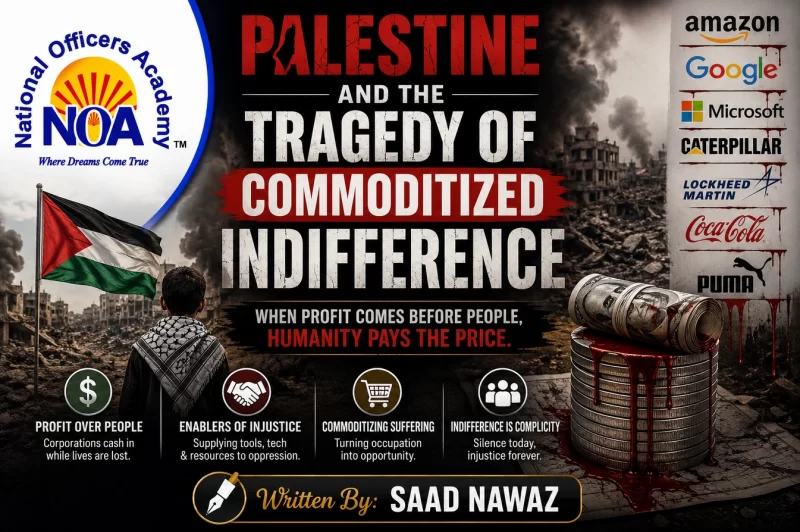
Palestine and the Tragedy of Commoditized Indifference
Role of Corporations in Facilitating Profit from Human Suffering
Written By: Saad Nawaz
“The darkest places in hell are reserved for those who maintain their neutrality in times of moral crisis.”
— Dante Alighieri, Inferno, Canto II
Introduction
The devastation unfolding in Gaza is not merely the result of military aggression, but of a structural order that thrives on silence and complicity.
Beyond the visible spectacle of airstrikes lies an intricate web of global commerce, financial flows, and political inertia that renders mass suffering sustainable.
Neutrality in the face of such violence is not an absence of choice. It is itself a choice — one that strengthens the machinery of oppression.
This article examines that machinery through a dialectical approach: beginning with the claims that legitimize economic and political actions, confronting the contradictions they conceal, and reaching syntheses that expose their true implications.
Gaza, in this framing, is not only a site of devastation but also a moral crucible, revealing the extent to which global systems subordinate justice to profit.
Corporations as Structural Participants in Conflict
At the heart of Gaza’s destruction lies an uncomfortable reality: corporations are not passive observers of conflict but active participants in its endurance.
The logic of profit renders them indispensable to the machinery of devastation, whether through arms production, technological supply, or logistical support.
The convenient defence is that commerce is apolitical, and that businesses merely deliver goods demanded by the market.
Yet such neutrality collapses when the outcome of these transactions is not abstract, but lived in the rubble of demolished homes and shattered communities.
The true synthesis is clear: when commerce directly sustains war, it cannot claim innocence.
To supply the means of destruction is to stand within the chain of violence itself.
In Gaza, corporations have ceased to be peripheral actors. They have become structural pillars of atrocity, transforming economic calculation into a quiet but decisive form of complicity.
The Military-Industrial Complex and the Commodification of Violence
The military-industrial complex represents the most visible nexus between profit and destruction.
In Gaza, the logic of militarisation is brutally simple: each airstrike doubles as a live demonstration for weapon systems later marketed to foreign buyers.
Advocates of this industry claim it is rooted in national security, a necessary response to instability in a hostile region.
But this rationale unravels when defence is converted into spectacle, and human suffering becomes proof of efficiency.
The synthesis is that Gaza has been transformed into a proving ground, where armaments are refined through blood and devastation.
This process does not end with local destruction. It reverberates globally, as weapons perfected on Palestinian bodies are sold on international markets.
Thus, militarisation does not merely defend. It commodifies violence, binding profit to annihilation in a cycle that rewards the perpetuation of conflict rather than its resolution.
Surveillance Technology and the Machinery of Control
If bombs reduce Gaza to rubble, technology ensures that its people remain under constant watch.
Surveillance, data analytics, and biometric profiling extend the battlefield into daily life, transforming an entire population into a monitored subject.
Technology corporations defend their role by claiming that their products are neutral or dual-use, designed for civilian administration or security.
Yet in practice, these systems facilitate precision strikes, targeted arrests, and the curtailment of basic freedoms.
The contradiction is unavoidable: technology that catalogues lives can just as easily extinguish them.
The synthesis is stark — digital infrastructure becomes a weapon no less decisive than artillery.
Gaza illustrates how innovation, once hailed as progress, collapses into an instrument of subjugation.
When algorithms dictate whose door is broken down or whose home is bombed, the distinction between civilian and military technology dissolves, leaving only the machinery of control.
Machinery, Land, and the Politics of Erasure
Where surveillance maps the body, machinery grinds the land itself.
Bulldozers, excavators, and armoured vehicles are presented as practical tools of urban management or defence.
Yet in Gaza, they serve a darker role: the systematic dismantling of homes, infrastructure, and terrain.
Industry claims these machines are value-neutral, equally capable of building or destroying.
But neutrality collapses in practice when steel claws and treads consistently tear down rather than construct.
The synthesis is visible in the dust and rubble: machinery becomes not an emblem of development but a partner in erasure.
Its very weight and mechanical force inscribe domination onto the landscape, ensuring that even the ground beneath Palestinian feet is subject to control.
Humanitarian Aid as Managed Survival
Humanitarian aid arrives draped in the rhetoric of salvation.
Food parcels, medical supplies, and temporary shelters suggest a lifeline cast toward the afflicted.
Yet aid often functions as an instrument of management rather than liberation.
By flowing through controlled checkpoints and conditional distribution, it transforms sustenance into leverage, reinforcing the very siege it claims to soften.
The contradiction is stark: a system that produces devastation also monopolizes the right to “alleviate” it.
The synthesis emerges as a cruel paradox — Palestinians are rendered dependent on the same structures that deprive them.
Aid thus becomes a performance of care that conceals the machinery of control, a means of keeping crisis sustainable rather than resolving it.
Global Media and the Spectacle of Suffering
The global media refracts Gaza through a prism of spectacle.
Images of rubble, wounded children, and mass funerals saturate screens, simultaneously evoking pity and fatigue.
On one side lies the claim of “bearing witness,” of exposing atrocities to mobilize conscience.
On the other side lies the reduction of suffering into consumable fragments, fleetingly cycled through the 24-hour news machine.
This contradiction strips the oppressed of narrative sovereignty. Their reality is mediated not as history, but as content.
The synthesis is grim: a spectacle that numbs as much as it agitates, ensuring that outrage never coheres into structural change.
Suffering becomes visible, yet politically inert.
International Law and the Failure of Universal Justice
International law presents itself as the universal grammar of justice, binding states to norms of human dignity.
Yet in Gaza, this grammar fractures.
Prohibitions against collective punishment, disproportionate force, and targeting civilians are recast as “exceptions” under the rubric of security.
On one side is the juridical promise of universality. On the other is the sovereign prerogative to suspend it.
The synthesis reveals law not as a neutral arbiter, but as an instrument pliable to power.
Its enforcement becomes contingent on geopolitics rather than principle.
Thus, the very framework that claims to protect life is hollowed out, legitimizing its violation.
The Palestinian Diaspora: Distance, Memory, and Resistance
The Palestinian diaspora embodies a paradox of distance and intimacy: estranged from the soil yet bound to its suffering.
In exile, memory becomes both burden and weapon, preserved through ritual, narrative, and protest.
Against this stands the global machinery of silencing, which brands solidarity as extremism and renders advocacy suspect.
The contradiction lies between the right to voice and the power to mute.
The synthesis is a transnational chorus that refuses erasure, where the Palestinian cause reverberates through campuses, streets, and cultural production.
Here, displacement becomes not silence but amplification, scattering the struggle into every geography touched by dispossession.
Digital Witnessing and the Politics of Exposure
The war in Palestine is mediated through screens, where suffering becomes both hyper-visible and disposable.
Drones, satellites, and algorithms script a theatre of control, while social media transforms atrocity into content.
The contradiction lies in exposure: images circulate endlessly yet fail to compel justice, the spectacle overwhelming conscience into numbness.
Yet the synthesis emerges in the cracks of control — citizen journalism, live-streams, and digital archives that resist erasure.
Technology, designed for domination, becomes appropriated as witness, turning the gaze back upon the oppressor and inscribing memory against the machinery of forgetting.
Reclaiming International Law from Power
International law proclaims universality yet is revealed as particular, a tool wielded by the strong against the weak.
War crimes are named selectively, sovereignty recognized conditionally, and justice deferred indefinitely.
The contradiction lies in the very promise of law: it is invoked as the language of humanity, yet its application betrays hierarchy and exclusion.
The synthesis, however, is found in the insurgent invocation of law by the oppressed.
Appeals to human rights tribunals, the mobilization of global civil society, and the insistence that universality must be reclaimed from its own betrayal all point toward another possibility.
In this demand lies the possibility of law not as an instrument of empire, but as the grammar of genuine justice.
Memory as Wound and Weapon
Memory functions as both wound and weapon.
Trauma threatens to paralyse the oppressed, binding them to cycles of grief and silence. Yet remembrance also resists erasure, refusing the finality of defeat.
History, when monopolized by the victors, becomes myth.
But when reclaimed by the oppressed, it transforms into prophecy.
The dialectic of memory is thus paralysis and mobilization, despair and hope.
Out of this tension emerges the future of resistance: not merely to survive the violence of empire, but to preserve the capacity to imagine beyond it.
For every attempt to bury history generates its opposite — an unquiet remembrance that insists on the unfinished work of justice.
Liberation as an Unfinished Horizon
The dialectics of empire and resistance refuse closure.
Every empire imagines its permanence, yet its contradictions inevitably produce decay.
Every act of resistance confronts defeat, yet its memory generates renewal.
Liberation is not a singular event but an ongoing process, a perpetual struggle between domination and emancipation, despair and defiance.
To speak of liberation, then, is to affirm a horizon rather than a destination.
It is a horizon shaped by the blood of the oppressed, the silence of the forgotten, and the unyielding insistence that another world is possible.
It is in this ceaseless oscillation, this restless movement between death and life, oppression and freedom, that the dialectics of history find their truest expression.
“This is the way the world ends / Not with a bang but a whimper.”
— T.S. Eliot, The Hollow Men