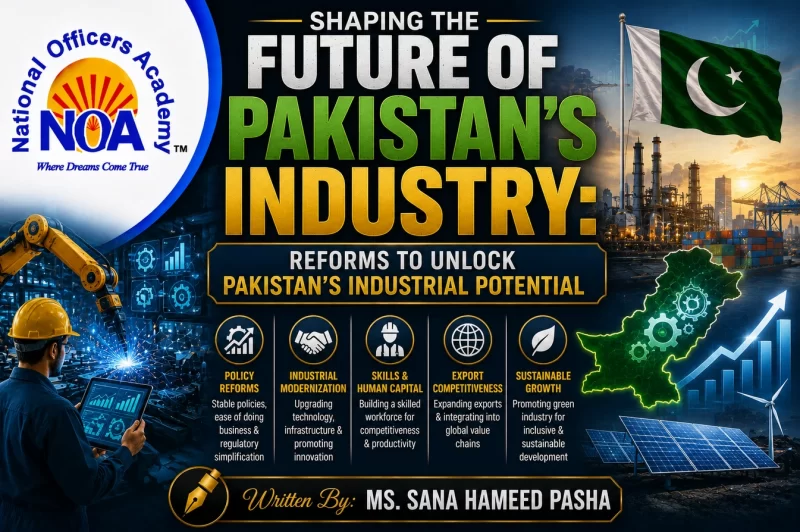
Shaping the Future of Pakistan’s Industry
Reforms to Unlock Pakistan’s Industrial Potential
Written By: Ms. Sana Hameed Pasha
Introduction
Pakistan’s mission statement, according to the Planning Commission, is:
“To help create knowledge-led, well-governed, enterprising and prosperous Pakistan through realistic and innovative policies and programmes delivered in the most cost-effective fashion.”
The fulfillment of this mission statement requires Pakistan to bring about structural change in its production and export structures through the identification of ideal products that can be profitably produced, given the country’s capabilities.
It also requires a smooth transition from a traditional agrarian economy to an industrialized economy.
In reality, Pakistan’s pace of structural transformation has been among the slowest and lowest when compared to other Asian countries.
Structural transformation involves the reallocation of economic activities within three sectors of the economy: agriculture, industry, and services.
It signifies a typical pattern of growth where an economy shifts from agriculture to industry, followed by a rise in the services sector, ultimately resulting in an elevated standard of living.
Therefore, structural transformation is considered a vital ingredient for inclusive growth.
Successful Asian economies made efficient use of this ingredient through industrial policies aimed at developing a sophisticated manufacturing sector that supports diversification and adoption of new inputs and methods of production.
Rostow’s Model and Pakistan’s Economic Growth
In the case of Pakistan, a skewed pattern of development is observed, where support is provided to specific areas and sectors while others remain neglected.
An evaluation of Pakistan’s development in line with Rostow’s five stages of economic growth reveals that the country has been unable to successfully transition from a traditional agricultural economy to a highly developed economy.
Rostow’s model holds great importance because it highlights the steps through which a traditional economy can transform into a highly specialized one.
Rostow specifically stresses the take-off stage and considers it the entry point for the economy into sustained growth and development.
A critical analysis of Pakistan’s historical development shows that the country met the conditions of Stage 2, known as Preconditions for Take-off, and since then has been fluctuating between Stage 2 and Stage 3, known as Take-off.
This is mainly because Pakistan has failed to consistently grow at 5% or more, which is a key requirement of the take-off stage.
Initially, in the 1960s, the country was successful in fulfilling the conditions of take-off, including increased investment in industrial sectors. This led to the establishment of industrial plants and the development of a key manufacturing sector, namely textiles.
However, the process of industrialization was not sustained in subsequent years.
According to numerous economists, the period between 2002 and 2007 is considered one where Pakistan was checking off all the conditions of the take-off stage with persistent positive growth.
However, it was followed by a negative economic outlook.
Pakistan has not followed the ideal trajectory of growth, as evidenced by the dismal contributions of agriculture and industry to overall output growth when compared to the services sector, which contributes more than 50% of GDP.
Issues Being Faced by the Industrial Sector
According to the Pakistan Bureau of Statistics, the industrial sector contributes approximately 21% to the country’s GDP.
Various sub-sectors contribute to the country’s growth, with manufacturing alone accounting for 14.5% of GDP.
This is followed by:
- Construction: 2.8%
- Mining and quarrying: 2.18%
- Electricity, gas, and water supply: 2.08%
Despite the immense importance of industrial development for overall economic growth, the sector is lagging and remains highly unproductive.
Several issues, both exogenous and endogenous, have hampered its development.
These include persistent energy crises, ineffective policies, overregulation, weak infrastructure, lack of skill development and innovation, disruptions in global supply chains, volatile foreign exchange markets, and fluctuating global demand.
Energy Crisis
Energy plays an important role in a country’s development and progression.
Industries heavily rely on continuous energy supply for output, and any disruption in this supply adversely affects productivity.
Numerous developing countries have suffered from the adverse impacts of energy crises, and Pakistan is no different.
However, countries such as India and Bangladesh provide examples of states that have ensured better energy security for their industrial sectors.
In Pakistan, this problem can be traced back to the 1990s, when a serious supply-demand imbalance was experienced.
Since then, the problem has only worsened.
The industrial sector is persistently plagued by frequent electricity outages coupled with high electricity costs.
Energy costs in Pakistan are nearly double those in competitive countries.
Poor electricity supply negatively affects a firm’s productivity and profitability, ultimately reducing exports.
According to the World Bank Enterprise Survey, the short supply of electricity is a severe constraint to doing business for approximately 25% of large industries and 12% of medium industries.
Industrial Policy Distortions
A sound industrial policy is imperative for economic growth and development.
It enables an economy to transition effectively from agrarian to industrial, while fostering diversification and broadening the export portfolio.
Therefore, industrial policy is considered a catalyst for a thriving industrial sector.
Contrarily, Pakistan’s industrial policies have largely been reactive rather than proactive and have done little to boost the industrial sector.
A brief account of Pakistan’s history reveals that the country has been oscillating between different approaches to industrialization, with the focus continually shifting to other sectors.
In the 1950s, the government started the policy of import substitution to boost exports.
In the 1960s, a shift of focus toward agriculture was observed due to the Green Revolution.
The 1970s are considered the era of nationalization, followed later by privatization.
More recently, policy trends have supported deindustrialization.
Instead of enabling growth, current policies are accelerating deindustrialization and weakening well-established sectors of the economy.
It can be inferred from this trajectory that frequent policy changes and political instability have made the sector uncompetitive in the global commodity market.
Problems in Regulatory and Legal Framework
In light of Pakistan’s improved ranking on the Ease of Doing Business Index, it is apparent that the country has adopted measures to improve its regulatory and legal framework.
However, there is still a long way to go.
Businessmen have to comply with a wide range of rules and regulations that have discouraged new entrants into industry.
Additionally, the requirement of obtaining no-objection certificates from federal, provincial, and local governments at different stages has made the process tedious for businessmen.
The cost of doing business has increased significantly due to multiple forms of taxation, such as advance tax and minimum tax based on turnover.
This is not only a problem for large established businesses but has also adversely affected new businesses.
It has even discouraged the culture of startups.
Lack of Diversification and Innovation
The industrial sector employs around 16% of the total labour force, with approximately 40% of the industrial workforce employed in the textile industry.
Statistics further reveal that roughly 80% of Pakistan’s manufactured exports consist only of textiles, clothing, carpets, and rugs.
Moreover, Pakistan has hardly made any progress in other areas such as electronics, machinery, and metal products.
The same is true for the engineering sector and capital goods sector, where there is high dependency on the production of simple components or assembly operations based on imported parts.
This reflects an over-reliance on textiles, food, and beverages.
It also highlights the lack of diversification in the export base, making the country vulnerable to global market fluctuations.
According to the Economic Complexity Index, Pakistan is ranked 101 out of 145 countries.
This indicates that Pakistan has a low level of diversity and variety in its export basket.
On the other hand, India is ranked 48, implying a higher level of complexity and diversification in its products.
This lack of diversification has made Pakistan’s economy less capable of responding to changing global demand and less able to benefit from globalization.
The value added by various industries in Pakistan from 1960 to 2023 shows boom-and-bust cycles.
It also shows a gradual decline in value addition by industry since 2010, with the decline picking up pace since 2021.
This suggests that value addition by the industrial sector to GDP has remained insignificant.
There has not been any major change in output and production patterns that could substantially increase industrial value addition.
Revamping Pakistan’s Institutional Framework
Energy Sector Reforms
Various analysts claim that Pakistan’s industry is teetering on the brink of collapse due to the ineffectiveness of current policies.
Urgent reforms aimed at rationalizing and reducing energy costs are the need of the hour.
Otherwise, the country will remain uncompetitive in the global market.
A multi-pronged and well-structured approach should be adopted with cooperation between federal and provincial governments.
Such policies should focus on enhancing energy efficiency.
A holistic approach is required to address major issues of the energy sector, including impractical energy policies and excessive reliance on non-renewable and costly fossil fuels.
Additionally, inefficient energy use and wastage must be addressed.
These problems arise from outdated transmission lines, line losses, power theft, inefficiencies of GENCOs and DISCOs, and short-sighted policy commitments with independent power producers.
To boost the industrial sector, there is an urgent need to reduce electricity prices.
For that, it is important to resolve IPP-related issues, revamp transmission lines, privatize GENCOs and DISCOs, and gradually shift toward renewable energy.
Pakistan should also utilize internal and untapped energy sources such as wind, hydropower, solar, and Thar coal.
This will reduce the burden on the import bill caused by dependence on hydrocarbons.
Companies willing to invest in renewable energy should be incentivized through tax breaks and subsidies.
Reforming Industrial Policy
The analysis of historical trends shows that Pakistan is deindustrializing prematurely.
The growth rate of the manufacturing sector is lagging far behind competitors such as India, Bangladesh, and Sri Lanka.
According to World Development Indicators, the share of manufacturing in GDP was around 17% in 2005, which declined to approximately 13% in 2023, with an average annual growth rate of 5%.
Pakistan needs an industrial policy that promotes efficiency, diversification, and production of value-added goods.
According to the Pakistan Business Council, a “Make in Pakistan” thrust is required to leverage the size of Pakistan’s domestic market for developing scale and competitiveness, ultimately fulfilling global demand.
This will only be possible if a sound industrial policy is accompanied by alignment with other policies, including trade policy, fiscal policy, energy policy, agriculture policy, labour laws, and capital markets.
Moreover, conflicts between federal, provincial, and interprovincial governments should be resolved to create harmony and coherence in the formulation and implementation of effective policies.
Regulatory oversight is another essential ingredient for Pakistan’s industrial policy.
It ensures fair competition and boosts investor confidence by simplifying operations.
Modernizing Trade Policy
Pakistan’s export-to-GDP ratio in 1999 was around 16%.
An empirical study reveals that if the country had maintained that level of export-to-GDP ratio, total merchandise exports would have reached $56 billion in 2022.
This would have been around 75% more than the current $32 billion.
Among other factors, ineffective trade policy is one of the major reasons behind this failure.
Trade and taxation policies are crucial for the promotion of industrialization and have significantly contributed to the weak performance of the industrial sector.
The National Tariff Commission should actively formulate tariff policies aimed at promoting industrial growth rather than merely generating revenue.
Moreover, domestic industry should be supported and protected from dumping.
A coherent trade-industrial strategy can help integrate local industries into global value chains, attract foreign direct investment, and encourage innovation and technology transfer.
Therefore, Pakistan’s trade policy must be aligned with industrial development goals.
Deregulation and Taxation
According to a study conducted in 2022, the cost of excessive regulations and sludge in the economy is approximately 60% of GDP.
The formal industrial sector is overregulated and heavily taxed.
This has hampered efficiency and productivity, resulting in a stagnant and sometimes declining share of manufacturing in GDP.
With a 13% contribution to GDP, the manufacturing sector is subjected to 58% of total tax revenue.
This shows a disproportionate tax burden on the sector.
Therefore, fiscal policy needs to be revisited to ensure an equitable distribution of the tax burden across all sectors.
The policy should focus on promoting capital formation and consolidation to facilitate competitiveness and investment.
Given the large footprint of government in industrial development, the state should focus on facilitating industrial activity and reducing regulatory burden.
Easing regulations and lowering tax incidence are important because they will encourage new companies to invest while allowing existing firms to expand operations and increase profitability.
A relevant measure could be to create specific centres that provide all necessary permits and licences in one location.
Furthermore, e-governance initiatives should be adopted to reduce time and enhance transparency.
Fostering Export Diversification and Complexity
Since its inception, Pakistan’s export basket has remained largely undiversified and low in complexity.
Exports have primarily concentrated on textile and agricultural products, resulting in stagnant export composition.
Without diversifying its production base, Pakistan cannot improve productivity or export performance.
Production of goods should be based on comparative advantage, global demand, and growth potential in sunrise industries.
While the government should strengthen the textile industry, which plays a vital role in the economy, it is also necessary to explore other sectors that could boost exports.
In this regard, the proper implementation of Pakistan’s Strategic Trade Policy Framework is extremely important.
The policy outlines necessary measures to promote product complexity and diversification, such as moving away from traditional exports like cotton, leather, and rice toward complex manufactured goods.
The problem lies in the effective realization of such policies, which needs to be addressed on a priority basis.
Human Capital Formation and Workforce Development
Pakistan faces an acute deficiency of skilled human resources, which are vital for technology-driven production capable of competing in global markets.
The labour market in the country is characterized by a shortage of middle-level skilled personnel and unemployment among educated persons.
The Human Capital Index ranks Pakistan 164th out of 193 countries.
This indicates that the country provides low-quality basic education and lacks emphasis on technical education.
Statistics also show a high level of learning poverty, with many university graduates unable to secure good employment opportunities due to insufficient employable skills.
To address this issue, reforms should focus on the provision of technical education at primary and secondary levels.
Universities should introduce programmes that promote STEM education.
STEM education integrates science, technology, engineering, and mathematics to foster problem-solving, critical thinking, and innovation skills.
Technical and vocational training institutes should be expanded to meet the changing needs of the industrial sector.
This will help Pakistan gain maximum benefit from the latest technological advancements.
An environment conducive to continuous learning and upskilling is necessary for increasing productivity, diversifying products, attracting investment, and contributing to industrial progress and economic development.
Nurturing Innovation and Seamless Technology Adoption
In a fast-evolving landscape where new technologies are constantly being developed, each more efficient and effective than the last, a country must focus on rapid technological absorption to stay competitive.
The promotion of research and development and innovation is of supreme importance for industrial development and competitiveness.
Furthermore, nurturing an innovative culture based on research and development is vital for long-term success.
Investment in research and development has remained very low.
It has significantly decreased from approximately 0.6% of GDP in the early 2000s to around 0.2% of GDP currently.
This means that the country loses out on cutting-edge products, new market opportunities, and enhanced productivity.
To counter this, both public and private sectors need to work together to secure sufficient funds for research and development.
Financial incentives should be given to firms for in-house research and development activities.
This will enable them to implement new innovative techniques and processes in line with changing demand patterns, preferences, and technology.
Research and development can also help combat the adverse effects of climate change by facilitating the transition to green technology and clean energy.
It can unlock methods that are sustainable and environmentally friendly.
Conclusion
Pakistan’s industrial sector possesses significant potential for growth but is currently beset by a complex interplay of historical legacies, policy missteps, and global economic dynamics.
To address the slow pace of industrialization, comprehensive reforms are required.
These reforms must directly tackle the major issues facing the sector, including energy shortages, policy distortions, overregulation, weak diversification, human capital gaps, and low innovation.
A coherent and forward-looking industrial policy is essential for building a more diversified and resilient industrial base that can compete with global competitors.
Additionally, the formulation of sound policies must be accompanied by effective implementation.
Policies that remain unexecuted are equivalent to having no policies at all.