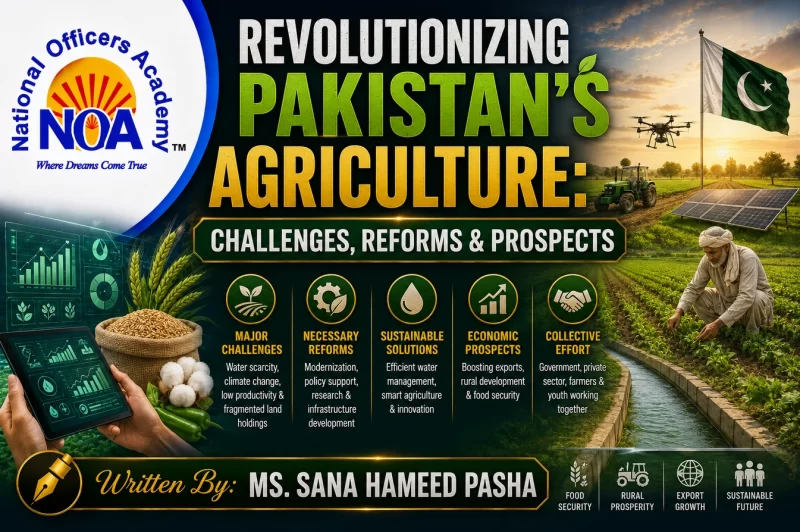
Revolutionizing Pakistan’s Agriculture
Challenges, Reforms & Prospects
Written By: Ms. Sana Hameed Pasha
“Pakistan’s economy cannot reach the desired level of seven to eight percent of GDP growth unless its agriculture sector grows at more than four percent.”
— Mr. Salim Raza, Former State Bank Governor
Introduction
Since its inception, agriculture has played a pivotal role in Pakistan’s economy, with significant contributions to the country’s Gross Domestic Product.
At the time of partition, Pakistan was a predominantly agrarian economy, with the agriculture sector contributing more than 60% to GDP and employing almost 80% of the labour force.
In the 1950s, stagnation was observed in the growth of this sector. This continued until the late 1960s, when the Green Revolution occurred and tremendous growth of more than 6% was recorded.
However, the post-Green Revolution era consisted of high volatility and fluctuations in agricultural growth.
Numerous researchers attribute this volatility to the unsustainable practices adopted during the Green Revolution, which resulted in significant resource degradation across the country.
Studies also reveal that developing countries like Pakistan, which attempted to develop their economies through industrialization rather than first strengthening agriculture, often face low economic growth rates coupled with income disparities.
According to the Pakistan Economic Survey 2023-24, Pakistan’s agriculture sector contributes approximately 24% to GDP and provides employment opportunities for 37% of the labour force. Around 62% of the rural population depends on this sector for livelihood.
Furthermore, the export of agricultural commodities makes up around 70% of total foreign exchange earnings. Therefore, the growth of this sector is crucial for strengthening the country’s export base.
The agriculture sector comprises four sub-sectors:
- Livestock: Considered the primary driver of agricultural growth, comprising around 60% of agricultural value added.
- Crops: Contribute approximately 38% to agricultural growth. During 2023-24, critical crops such as cotton, sugarcane, rice, and wheat contributed 4.97% to GDP, whereas other crops such as bajra, gram, jowar, and barley contributed 3.25%.
- Fisheries: Contribute approximately 2% to the overall growth of the agricultural sector.
- Forestry: Contributes approximately 2% to the overall growth of the agricultural sector.
Despite its immense importance for food security and economic growth, the sector faces challenges that have hindered its growth and sustainability.
These challenges include rapid population growth, urbanization, climate change, weak infrastructure, poor research and development, and gender inequality.
The Global Food Security Index 2022 ranks Pakistan 84th out of 113 countries, with almost 60% of the population experiencing food insecurity.
Major Challenges Being Faced by the Sector
Escalating Evidence of Climate Change
Climate change is now a widely recognized universal truth and one of the most pressing challenges for Pakistan.
In the Global Climate Risk Index, Pakistan is ranked among the top ten most climate-vulnerable countries in the world.
The country is highly susceptible to extreme weather events such as floods and droughts, which disrupt agricultural production.
Recurring periods of severe droughts followed by devastating floods have worsened the adverse effects of climate change on crop yields and food shortages.
According to the National Climate Change Policy, Pakistan experiences an increase in average temperature of 0.6°C per decade, leading to negative effects on crop yields.
In this regard, the World Bank conducted a study to estimate the impact of climate change on the possible decline in the yield of major crops and also illustrated the impact of climate change on net trade in Pakistan.
Water Scarcity
Water scarcity is another critical issue, as the agriculture sector consumes approximately 60% of Pakistan’s freshwater resources.
With the continuous rise in population and agricultural production, the demand for water resources is increasing day by day. This puts additional pressure on already limited resources.
Pakistan relies heavily on the Indus River system for irrigation, but over-extraction and mismanagement have led to significant water shortages.
The rapid decline in water availability per capita poses a threat to the sustainability of irrigated agriculture, which accounts for 90% of total agricultural output.
According to United Nations estimates, Pakistan’s water demand is rising at an average annual rate of 10%, posing a significant threat to already stressed water resources.
Land Degradation and Deteriorating Soil Health
Soil health and fertility are among the most fundamental factors for agricultural production.
Crops grow in soil that is rich in essential macro and micronutrients such as nitrogen, phosphorus, potassium, calcium, and magnesium.
Healthy and fertile soil allows better water infiltration, effective soil moisture conservation, and overall better crop productivity.
Land degradation due to soil erosion, salinity, and nutrient depletion is a major concern for Pakistan’s agriculture.
The Food and Agriculture Organization estimates that around 50% of Pakistan’s agricultural land is affected by salinity, which hampers productivity.
Moreover, the increasing use of chemical fertilizers without proper management has led to soil degradation, threatening long-term agricultural sustainability.
According to the Pakistan Economic Survey 2023-24, approximately 57.88 million hectares of Pakistan’s land is degraded, suffering from salinity, erosion, and loss of fertility.
Inadequate Infrastructure
The agricultural sector in Pakistan suffers from inadequate infrastructure, including poor transportation networks and insufficient storage and processing facilities.
This limits farmers’ access to markets and leads to post-harvest losses, estimated at 30% for fruits and vegetables.
The lack of cold storage and processing facilities further worsens the issue, reducing farmers’ incomes and limiting their ability to compete in domestic and international markets.
Lack of Research and Development and Technological Gaps
Pakistan’s agricultural productivity remains low compared to regional peers.
Factors contributing to low productivity include traditional farming practices, limited access to modern technology, lack of access to agricultural credit, and insufficient investment in research and development.
It is estimated that only about 25% of farmers have access to modern technologies and practices.
A comparison of Pakistan with regional peers reveals that Pakistan’s crop yields are significantly lower than those of other countries.
For instance, the average wheat yield stands at 2.5 tons per hectare, whereas the world average is approximately 3.5 tons per hectare.
Therefore, there is an urgent need to bridge technological gaps in order to address the problem of low productivity.
Lack of Education and Training of Farmers
Among the problems in the agriculture sector, the poor knowledge and training of farmers is one of the most neglected.
Farmers carry out day-to-day activities on farms, and agricultural productivity is directly dependent on their efficiency.
Even though the agriculture sector is developing, it has been unable to keep up with the latest practices being followed around the world.
Farmers lag behind due to insufficient training in new technologies.
The government has established Technical Education and Vocational Training Authorities in each province, but the generalized programmes being offered fail to address the dynamic and multi-faceted needs of the agriculture sector.
Therefore, their effectiveness remains questionable.
Transforming Pakistan’s Agriculture: A Blueprint for Structural Reforms
Climate-Smart Agriculture: Sustainability and Environmental Practices
Climate-Smart Agriculture is a set of strategies focused on increasing food production, improving agricultural resilience to climate change, and reducing agriculture’s contribution to climate change.
These strategies include the use of drought-resistant crop varieties, efficient irrigation techniques, water management strategies, and renewable energy technologies.
The effectiveness of Climate-Smart Agriculture strategies depends heavily on the selection of techniques and methods that are uniquely tailored to regional conditions.
For example, laser land leveler technology is considered more useful for India and Pakistan, but less effective for Bangladesh and Nepal, due to its greater effectiveness for larger land sizes.
Another important factor is the enhancement of the organizational capacity of institutions dealing with the agriculture sector.
Since resources are often inadequate, optimal allocation of available resources is extremely important.
Moreover, the adoption of Climate-Smart Agriculture strategies must be linked with regular post-adoption follow-up, monitoring, and evaluation.
Therefore, a system-level approach is needed to deal with all strategies together and ensure long-term sustainable outcomes.
Adoption of Modern Technology
In Pakistan, outdated farming practices have adversely affected agricultural productivity and potential.
The incorporation of the latest and improved technology can pave the way for higher yields with minimum input and cost.
It can also generate employment opportunities, increase farmers’ incomes, and contribute to overall poverty reduction.
The focus should be on knowledge-intensive agriculture, as Fourth Industrial Revolution technologies are bringing revolutionary changes to agricultural sectors around the world.
These technologies include:
- Artificial intelligence techniques
- Smart sensors for tracking soil health and weather conditions
- AI-powered agricultural drones
- Advanced seed technology
- Automated harvesting machines
In light of increasing evidence of climate change, technological advancements must be based on climate-smart agricultural practices.
This approach ensures equitable benefits while making agriculture resilient against harmful climate change effects.
The government can facilitate access to new technology through training programmes, partnerships with technology companies, and increased investment in research and development.
In this regard, the Netherlands can be studied as an exemplary case of growth and development driven predominantly by the agriculture sector.
The country enjoys a robust framework that fosters collaboration between government, agriculture, industry, and research institutions.
Infrastructure Development: Investing in Transport and Storage Facilities
A well-developed and reliable infrastructure is vital for effective output in the agricultural sector.
Post-harvest losses are a major issue, leading to significant wastage of crops.
These problems stem from the lack of proper storage and transport facilities.
The lack of cold storage and processing facilities makes it difficult for farmers to preserve crops.
Furthermore, road networks are damaged in remote rural areas of Pakistan, increasing the cost and duration of transportation and making markets inaccessible to many farmers.
Investment in infrastructure development should therefore be prioritized.
This should include:
- Construction and restoration of rural road networks
- Enhancement of cold storage facilities
- Development of processing facilities, particularly for perishable goods
Public-private investment can also play an important role in mobilizing resources for development.
Ultimately, advanced infrastructure will result in crop preservation, reduced losses, and increased farmers’ incomes.
Crop Diversification and Value Addition
Traditionally, Pakistan’s agriculture sector has been dominated by a few crops such as wheat, rice, and sugarcane.
The country has not fully unlocked its potential in the production of other crops.
Given the wide-ranging issues facing the sector, diversification in crop production is essential.
Crop diversification can make the agriculture sector less vulnerable to global price fluctuations and changing climate patterns.
Diversification can particularly be carried out by promoting high-value and low-water crops, including:
- Fruits and vegetables such as citrus fruits, grapes, apples, tomatoes, and potatoes
- Legumes and pulses such as lentils and chickpeas
- Oilseeds such as sunflower and canola
- Drought-resistant and climate-resilient crops such as millets and varieties of pulses
These crops are less water-intensive compared to rice and sugarcane.
Adopting crop diversification strategies requires consideration of several important factors.
These include farm and farmer characteristics, location-specific attributes, and exposure to floods or excessive rainfall.
Important characteristics include farm accessibility to the main city or markets, the farmer’s knowledge and access to information, and the farmer’s risk preferences.
Therefore, a holistic approach based on equipping farmers with resources and knowledge is required for effective crop diversification.
Additionally, region-specific diversification and targeted policy interventions are also necessary.
Credit Enhancement: Financial Services
In developing countries like Pakistan, agricultural production is inherently low due to traditional farming practices, limited use of modern technology, and a high number of small farmers.
Consequently, significant perceived risks are associated with agricultural income and production.
This makes the provision of agricultural credit to smallholder farmers unattractive for many financial institutions.
Currently, major formal sources of credit include Zarai Taraqiati Bank Limited, commercial banks, and cooperative companies.
Although several initiatives have been taken by the government to increase agricultural credit, farmers in Pakistan still have limited access to credit, especially those in remote areas.
This is due to long distances from credit institutions, collateral requirements, and interest charges, all of which disadvantage small farmers.
To address these challenges, possible measures include waiving certain agricultural credit burdens and relaxing collateral conditions so that financially strained farmers can receive relief.
Moreover, the per-acre credit amount should be increased in line with inflation, as inflation affects farmers’ purchasing power and their ability to procure quality inputs.
It is also important for the country to ensure easy access to credit facilities for farmers across all regions.
Overhauling the Irrigation System
Pakistan relies heavily on irrigation and has an extensive irrigation system based on rivers, dams, barrages, and canals.
In this regard, revamping the canal system is the need of the hour, as inefficiencies caused by water losses are proving detrimental to the entire agriculture sector.
A possible solution is to line major canals with concrete to prevent seepage and evaporation, along with regular maintenance of the canal network.
Furthermore, adopting more water-efficient irrigation systems, smart water distribution technologies, and decentralized water management systems such as drip irrigation and sprinkler systems can result in more precise water delivery and effective water management.
Soil Health and Fertility Management
Pakistan’s agriculture sector suffers from poor soil health and fertility, which has hampered crop productivity and worsened food insecurity.
The problems stem from outdated farming practices, over-reliance on chemical fertilizers, water wastage, and water mismanagement.
The situation is further worsened by deforestation and the adverse impacts of climate change.
To improve soil health and fertility, the government can implement several strategies.
These include adoption of organic farming practices and balanced use of fertilizers.
The use of green manure and compost can enrich soil nutrients.
Crop rotation and cover cropping can also reduce pest cycles and prevent erosion by replenishing soil nutrients and enhancing organic matter.
Prioritizing Agriculture Education
The effective adoption of new farming practices and technological advancements depends heavily on the capabilities of farmers.
New methods require highly skilled farm workers.
Any reform will only be successful when farmers are equipped with the necessary skills to adopt the latest farming techniques, handle high-yield variety seeds, and use modern inputs.
Although the government has taken initiatives to educate farmers through technical training and research institutes such as the National Agriculture Education Accreditation Council and the Agriculture Polytechnic Institute established by the Pakistan Agricultural Research Council, these initiatives have not produced sufficiently promising results.
As the agriculture sector becomes more capital-intensive, these institutes must make a conscious effort to produce technically proficient farmers.
These farmers should be capable of undertaking farming operations in line with emerging agricultural requirements and practices, particularly climate-smart agriculture techniques.
Conclusion
Pakistan’s agriculture sector possesses substantial potential for economic growth, rural development, and food security.
However, it faces several challenges that require immediate attention.
Over the past 75 years, the average growth rate of agriculture has been approximately 3%, reflecting limited investment and weak reform efforts in the sector.
Numerous studies have demonstrated that real agricultural value added has a significantly positive effect on per capita real GDP in the long run.
This reiterates the importance of developing and investing in the agriculture sector.
Now, more than ever, Pakistan needs a paradigm shift for a competitive and sustainable agriculture sector.
The country possesses the capacity to revolutionize its agricultural landscape.
For this, a holistic approach involving the effective implementation of relevant structural reforms is of utmost importance.