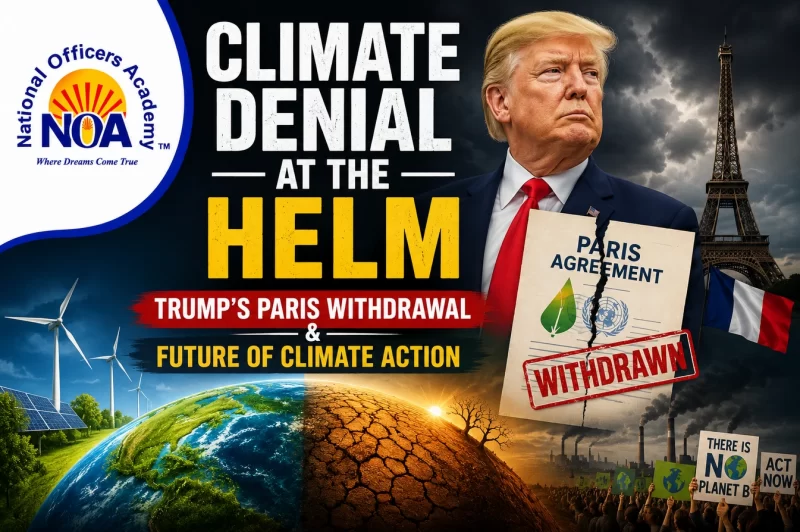
Climate Denial at the Helm
Trump’s Paris Withdrawal & Future of Climate Action
“I’m immediately withdrawing from the unfair, one-sided Paris climate accord. The United States will not sabotage its own industries while China pollutes with impunity.”
— Donald Trump
Introduction
President Donald Trump’s attitude toward climate science is, as it has always been, contradictory and sceptical.
His interest in elevating the United States economy defines his anti-climate policy stance.
While climate change remains a global concern, with scientific consensus linking it to human-driven causes, Trump has called it a hoax and believes that climate regulations weaken manufacturing and fossil fuel industries.
He seeks to approve new drilling and expand domestic fossil fuel production.
Trump’s climate policies, both during his first presidency from 2017 to 2021 and in his current term, dismiss climate alarm.
Most importantly, his withdrawal from the Paris Climate Accord in 2017, and the second-time withdrawal of the world’s second-biggest polluter, raise serious concerns about the severity of climate setbacks.
The pace of emissions reduction efforts needs the United States and its national interests to fight consistent warming within and outside U.S. borders.
However, the lack of U.S. engagement in climate action also places the commitment of other leaders at risk, while climate change continues to undermine sustainable development globally.
Trump’s Views on Climate Change: “Drill, Baby, Drill”
U.S. President Donald Trump’s perspective on climate change is straightforward.
His environmental policies and strong emphasis on fossil fuel production are captured in the slogan “Drill, Baby, Drill.”
This slogan was frequently used during his previous campaigns and presidency, and also in his inaugural address as the 47th President of the United States, to show his commitment toward domestic oil and gas production.
Not only did the Trump administration deny the existence of climate change, but it also declared a national “energy emergency.”
Alongside that, he opened protected areas such as the Arctic National Wildlife Refuge for oil and gas drilling.
Trump does not want the United States to rely on foreign oil.
Therefore, his administration’s broader strategy is to shift complete focus toward domestic production.
According to Rachel Cleetus, the policy director for the Union of Concerned Scientists’ Climate and Energy programme:
“This is a very different and more dangerous Administration than the first time around.”
This could be because the world is continuously warming, yet the Trump administration prioritizes economic development over environmental sustainability.
USA and Climate Change: An Unhappy Marriage
Despite these challenges, the United States has made efforts to address climate change.
These efforts include ratifying the Paris Agreement and setting a goal to reduce greenhouse gas emissions by 50% by 2030.
However, inconsistencies persist.
For example, the continuation of tax breaks for oil and gas companies undermines the country’s climate objectives.
Climate change, once a non-partisan concern, has become a polarizing issue in the United States.
The oil industry’s awareness of the link between fossil fuels and global warming dates back to the 1970s, yet it funded climate denial efforts for years.
Despite overwhelming scientific consensus, a significant portion of Americans, about one-third, still disputed the existence of human-caused climate change as recently as 2021.
However, a majority of Americans continue to express concern or alarm about the issue.
Progress Made Toward Combating Climate Change
Kyoto Protocol
The Kyoto Protocol was the first global climate treaty that laid the foundation of climate action toward reducing greenhouse gases in the atmosphere.
It was adopted in Kyoto, Japan, in 1997 and came into force in 2005.
It is legally binding and currently has 192 member countries.
Under this treaty, developed countries were required to complete their targets for reducing greenhouse gases.
Developing countries were encouraged to reduce their emissions, but they were not given specific targets.
However, the United States never ratified it, and Canada withdrew in 2012.
Bali Action Plan
In 2007, during COP 13 in Bali, Indonesia, an agreement was signed to renegotiate and reinvigorate international climate negotiations.
This laid the framework for future climate agreements such as the Copenhagen Accord and the Paris Agreement.
For the first time, there was a shift in focus from mitigation to adaptation, technology transfer, and financial assistance to developing countries.
It also laid the groundwork for reducing global warming to below 2°C above pre-industrial levels, which was later incorporated into the Paris Agreement.
Copenhagen Accord
The Copenhagen Accord was adopted in 2009 at the 15th COP in Copenhagen, Denmark.
The accord was signed between the United States and BASIC countries: Brazil, South Africa, India, and China.
It set a goal of providing $100 billion by 2020 and $30 billion between 2010 and 2012 for adaptation and mitigation in developing countries by developed economies.
Developed countries also agreed to submit their greenhouse gas reduction targets by January 31, 2010.
However, the accord was non-binding and was drafted by only five countries.
Paris Agreement
COP 21, or the Paris Climate Agreement of 2015 in France, was a historic deal in the history of global climate efforts.
Its main features were as follows:
- It was the first major binding agreement signed by 195 countries and major multinational companies.
- Its central aim was to keep global temperature rise below 2°C, ideally 1.5°C above pre-industrial levels.
- All major emitters agreed on reducing emissions under their respective voluntary climate action plans called Nationally Determined Contributions.
- Every country had to submit its performance after every five years.
- The agreement gave a comprehensive plan for plantation and carbon sinks, known as the Bonn Challenge, to be adopted by every party, including countries and multinational companies.
- The $100 billion climate fund target set at Bali and Copenhagen climate conferences was made binding and was to be achieved by 2020.
- A global stocktake is conducted after every five years to assess collective progress made toward addressing climate change.
The Paris Agreement is widely praised for creating global consensus on climate action.
However, it is also criticized for not fulfilling its commitments in letter and spirit, as global warming continues to rise.
Trump’s Withdrawal from the Paris Agreement: Assessing the Impact
Undermining Global Cooperation on Climate Change
President Trump’s decision weakens the multilateral system and sets a bad precedent for others to follow.
The Paris Agreement is the most comprehensive treaty on climate change and has been agreed upon by almost all countries of the world.
With the United States, the world’s largest economy and second-largest CO2 emitter, outside its orbit, the progress made toward limiting global temperature rise to 2°C may begin to unravel.
Increasing Greenhouse Gas Emissions in the Atmosphere
A Carbon Brief analysis revealed that a second Trump term could result in an additional 4 billion tons of U.S. emissions by 2030 compared to Joe Biden’s plans.
This could cause global climate damages worth over $900 billion.
Moreover, the Biden administration had set a target of increasing renewable energy by 50% by the middle of the next decade in its Paris Agreement commitments.
However, under Trump’s withdrawal, this target now appears difficult to achieve.
Reducing Financial Assistance for Developing Countries
The United States has been a major source of financial assistance for climate-vulnerable countries.
For example, the Obama administration pledged $3 billion to the Green Climate Fund.
Out of this amount, $2 billion are yet to be delivered.
However, the first Trump administration did not honour this commitment.
Likewise, at COP 29, pledges of $300 billion per year were made to developing countries.
But as Trump threatens to leave the Paris Agreement, this financial support may no longer be possible at the same level.
Emboldening Other Countries to Leave the Agreement
Argentina’s newfound hesitation toward the Paris Agreement is a concerning development.
Under President Javier Milei’s leadership, the country has started reassessing its commitment to the accord.
Argentina also withdrew its delegation from the COP 29 climate talks in Baku, Azerbaijan.
This move, coupled with Milei’s meeting with former U.S. President Trump at Mar-a-Lago, raises concerns that the U.S. withdrawal from the Paris Agreement may inspire other nations to follow the same path.
Creating a Leadership Vacuum for Other Nations
In 2017, when Trump made an unsuccessful attempt to withdraw from the Paris Agreement, countries such as France, Germany, Italy, and China gave strong reactions and indicated that they would increase their efforts to address climate change.
However, at that time, U.S. withdrawal took four years to complete and came into effect on November 4, 2020, just one day before the U.S. election in which Trump lost.
In early 2021, Joe Biden rejoined the agreement.
As a result, there was a leadership vacuum for only a few months.
This time, however, the United States may exit the agreement by 2026, creating space for countries such as China and the United Kingdom to expand their climate leadership roles.
Can China Lead the World?
China is poised to spearhead global efforts in combating climate change due to its substantial investments in renewable energy and growing commitment to reducing greenhouse gas emissions.
As the world’s largest CO2 emitter, China’s actions will significantly influence global climate change mitigation efforts.
Notably, China has made significant progress in transitioning to a low-carbon economy.
By 2022, non-fossil fuels accounted for 17.5% of its primary energy consumption.
China aims to increase this share to approximately 25% by 2030, focusing on expanding its solar and wind power capacity.
It has more than 80% of the world’s solar manufacturing capacity.
In 2022, Beijing invested a staggering $546 billion in clean energy, accounting for 50% of the global total.
Likewise, China’s company BYD is the world’s biggest electric vehicle manufacturer.
Some of China’s key climate commitments include:
- Reaching peak CO2 emissions before 2030, potentially as early as 2024.
- Achieving carbon neutrality before 2060, requiring substantial greenhouse gas emissions reductions.
- Increasing wind and solar power capacity to over 1,200 gigawatts by 2030, reducing reliance on fossil fuels.
Although China’s progress is promising, concerns persist about its continued reliance on coal and its relatively slow pace of greenhouse gas emissions reduction.
Nonetheless, China’s leadership in addressing climate change is vital, and its actions will likely have a significant impact on global climate mitigation efforts.
Are COPs Really Effective?
COP stands for Conference of the Parties, the largest annual climate crisis conference held by the United Nations.
The concept of COP originated from the 1992 United Nations Framework Convention on Climate Change.
The inaugural COP 1 took place in Berlin in 1995.
Despite many challenges, the value of COPs has increased over time.
They are criticized for lacking effective enforcement mechanisms, controversial host locations, and limited representation of indigenous people and women.
Nevertheless, COPs enable global climate cooperation as representatives from 197 countries gather in one place to collaborate on meaningful climate action.
COPs also provide a platform for vulnerable nations to demand climate action and funding.
Most importantly, COPs serve as a focal point for mass demonstrations and climate activism.
Conclusion
Although President Trump’s unilateral decision has far-reaching effects, it must be kept in mind that without the United States, which emits around 10% of global emissions, 90% of global emissions are still represented under the Paris Agreement.
There is hope that efforts to save the planet from global warming will continue.
However, this hope can only be materialized when major carbon emitters adhere to their commitments to cut emissions.
At the same time, globally coordinated efforts led by strong climate leadership remain essential.
Without consistent U.S. engagement, the Paris Agreement may survive, but the pace and effectiveness of global climate action could be seriously weakened.