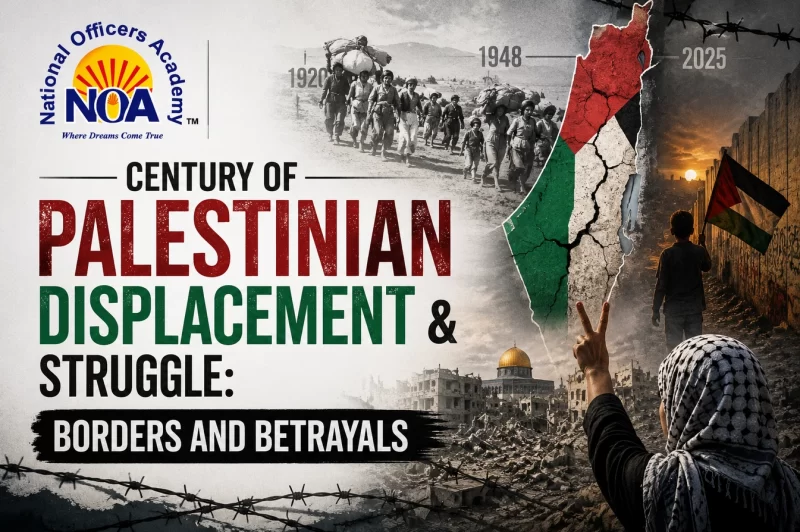
Century of Palestinian Displacement & Struggle
Borders and Betrayals
Introduction
The Palestine issue is the long-standing conflict over land, identity, and sovereignty between Palestinians and Israel.
It is one of the world’s most complex and enduring disputes, rooted in colonial history, displacement, and competing nationalist movements.
The conflict has led to wars, occupation, humanitarian crises, and ongoing struggles for self-determination.
The conflict between Israel and the Palestinian people is one of the most violent disputes in the world.
Its origins go back more than a century.
There have been a series of wars between Israel and Arab nations.
Repeated uprisings, called Intifadas, against Israeli occupation, and reprisals and crackdowns by Israel have also taken place.
The consequences of this historic dispute over land, borders, and rights are still being felt today, including the latest war between Israel and Hamas in Gaza.
The displacement of Palestinians, often referred to as the Nakba, meaning catastrophe, began in 1948 and continues in various forms to this day.
Events of Displacement
The Palestinian displacement has passed through several key events and phases.
These events shaped the modern Israel-Palestine conflict and continue to influence regional and global politics.
Balfour Declaration
The Israel-Palestine issue goes back nearly a century, when Britain, during the First World War, pledged to establish a national home for the Jewish people in Palestine under the Balfour Declaration.
On October 31, 1917, British forces captured Palestine from the Ottoman Turks, ending nearly 1400 years of Islamic rule over the region.
Before the British Mandate in Palestine, Jews made up only around 6% of the total population.
In 1917, British Foreign Secretary Arthur Balfour authored the declaration on the basis of which the Israeli state was later established in the heartland of Palestine.
This declaration became one of the earliest turning points in the Palestinian struggle.
Migration of Jews
Large-scale Jewish migration to Palestine began and was later accelerated by Jewish people fleeing Nazism in Europe.
Between 1918 and 1947, the Jewish population in Palestine increased from 6% to 33%.
Palestinians were alarmed by this demographic change, and tensions rose.
This led to the Palestinian revolt from 1936 to 1939.
Meanwhile, Zionist organizations continued to campaign for a Jewish homeland in Palestine.
Armed Zionist militias also began attacking Palestinian communities, forcing many people to flee.
Zionism, which emerged as a political ideology in the late nineteenth century, called for the creation of a Jewish homeland.
UN Partition Plan, 1947
As violence spread across Palestine, the matter was referred to the newly formed United Nations.
In 1947, the United Nations adopted Resolution 181, which called for the partition of Palestine into Arab and Jewish states.
Under this plan, around 55% of the land was given to Jews, while Arabs were granted around 44%.
Jerusalem, which made up about 1%, was declared a separate internationalized territory.
The city is currently divided between West Jerusalem, which is predominantly Jewish, and East Jerusalem, which has a majority Palestinian population.
Israel captured East Jerusalem after the Six-Day War in 1967, along with areas of the West Bank.
This step has not been recognized by the international community.
The Old City in occupied East Jerusalem holds religious significance for Christians, Muslims, and Jews.
It is home to the Al-Aqsa Mosque compound, known to Muslims as Al-Haram Al-Sharif and to Jews as the Temple Mount.
In 1981, the United Nations designated it a World Heritage Site.
The Nakba
Leading up to Israel’s creation in 1948, more than 750,000 Palestinians were ethnically cleansed from their homes by Zionist militias.
This mass exodus became known as the Nakba, or catastrophe.
More than 500 Palestinian villages were destroyed and captured.
Some Palestinians became internally displaced and settled in camps in the West Bank and Gaza.
However, the majority were forced to flee to Jordan, Lebanon, and Egypt.
The Nakba remains the central wound in Palestinian national memory and continues to shape the demand for the right of return.
Six-Day War, June 1967
In June 1967, five Arab states — Egypt, Syria, Iraq, Lebanon, and Jordan — fought a six-day war against Israel.
The Arab states lost the Golan Heights, Sinai Peninsula, East Jerusalem, the West Bank, and Gaza.
After the war, new Jewish settlements started, and around 300,000 Palestinians were forcibly displaced.
Following the Six-Day War, military occupation expanded with forced displacement and land confiscation.
Properties were demolished, and residents were subjected to harsh military control.
Israel declared the annexation of East Jerusalem in 1980.
However, the international community still considers East Jerusalem an occupied territory.
Palestinians want East Jerusalem as the capital of their future state.
Lebanon Civil War and Palestinian Refugees
The Lebanon Civil War broke out in 1975 and continued until 1990.
During this period, the Israeli army invaded Lebanon, and more Palestinians were displaced.
The most notable events include the Sabra and Shatila massacres.
These were among the most harrowing massacres committed during the Lebanese Civil War.
Shatila, a Palestinian refugee camp, and the adjacent neighbourhood of Sabra are located southwest of Beirut, Lebanon’s capital city.
The refugees were mainly victims of the 1948 Nakba.
From September 16 to 18, 1982, the refugee camps of Shatila and Sabra were attacked by a right-wing Lebanese militia in coordination with the Israeli army.
Between 2,000 and 3,500 people were killed.
Oslo Accords, 1993
In 1993, Palestinian leader Yasser Arafat and Israeli Prime Minister Yitzhak Rabin signed the Oslo Accords.
The accords aimed to achieve peace within five years.
It was the first time the two sides recognized each other.
A second agreement in 1995 divided the occupied West Bank into three parts: Area A, Area B, and Area C.
The Palestinian Authority, which was created after the Oslo Accords, was offered only limited rule over 18% of the land.
Israel effectively continued to control the West Bank.
However, the Oslo Accords slowly broke down as Israeli settlements rapidly grew in the West Bank.
The Illegal Jewish Settlements
The settlement population in the West Bank and East Jerusalem grew from approximately 250,000 in 1993 to up to 700,000 by September 2024.
About three million Palestinians live in the occupied West Bank and East Jerusalem.
The building of Israeli settlements and the separation wall on occupied territories has fragmented Palestinian communities and restricted their mobility.
About 700 road obstacles, including 140 checkpoints, exist across the West Bank.
Around 70,000 Palestinians with Israeli work permits cross these checkpoints during their daily commute.
These settlements are declared illegal under international law.
The United Nations has condemned settlements, calling them a major hurdle in the realization of a viable Palestinian state as part of the two-state solution.
Gaza Blockade, 2007
Gaza is a narrow strip populated by around two million Palestinians and is often described as the world’s largest open-air prison.
To the south is Egypt, where the border is sealed and controlled.
To the west is the sea, which is controlled by the Israeli military.
The rest of the border is with Israel and is heavily sealed.
Israel imposed a blockade on Gaza in 2007 after Hamas came to power.
The siege continues to date.
Israel imposed a total blockade on the Gaza Strip on October 9, 2023, cutting supplies of electricity, food, water, and fuel after the Hamas attack inside Israel.
Current Scenario
Following the 2007 Gaza blockade, massive destruction was caused in Gaza in 2008, 2009, 2012, 2014, and 2023.
On October 7, 2023, Gaza was brutally attacked by the Israeli army.
This resulted in around 1.9 million human displacements, with little chance of return as western and central Gaza were heavily destroyed.
This further added to the refugee count of around 5.9 million.
Today, about five million Palestinians live in Gaza, the West Bank, and East Jerusalem.
Around 1.6 million Palestinians are citizens of Israel.
Together, this makes up about half of the total Palestinian population.
The other half lives in other countries, including Arab countries.
There are about 14.7 million Jews around the world today, of which 84% live in Israel and the United States.
The rest live in other countries, including France, Canada, Argentina, and Russia.
Palestine Issue, Ongoing Situation and Response from the World
Palestine Issue and Trump’s Stance
The stance of Donald Trump has always been controversial regarding the Israel-Palestine conflict.
During his presidency from 2017 to 2021, Donald Trump took a strongly pro-Israel stance.
His administration shifted U.S. policy significantly away from earlier positions that aimed at a two-state solution.
His administration made several controversial moves that were widely seen as favouring Israel at the expense of Palestinian rights.
Trump’s Stance Since 2017
On December 6, 2017, Trump officially recognized Jerusalem as the capital of Israel.
This broke with decades of U.S. policy.
The move sparked global protests, including Palestinian demonstrations and condemnation from the United Nations.
It was a major blow to Palestinian claims to East Jerusalem as their capital.
On May 14, 2018, the U.S. embassy was moved from Tel Aviv to Jerusalem.
This was seen as an endorsement of Israeli sovereignty over the entire city.
It led to violent protests in Gaza, where Israeli forces killed over 60 Palestinian protesters near the border.
Trump also cut funding to the United Nations Relief and Works Agency, which supports Palestinian refugees.
He cut aid to Palestinian institutions and closed the Palestine Liberation Organization office in Washington, D.C.
These steps worsened humanitarian conditions in the West Bank and Gaza.
They also weakened Palestinian leadership and its ability to negotiate.
Refugee aid to Jordan, Lebanon, Egypt, Syria, and Gaza was also significantly reduced.
Trump recognized Israel’s annexation of the Golan Heights, a territory captured from Syria in 1967.
This strengthened Israeli control over occupied territories and set a precedent for future annexation ambitions in the West Bank.
Trump’s administration also proposed a peace plan in January 2020 that heavily favoured Israel.
Key points of the plan included:
- Allowing Israel to annex large parts of the West Bank
- Giving Palestinians a fragmented, demilitarized state with limited sovereignty
- Declaring Jerusalem as Israel’s undivided capital
- Offering $50 billion in economic aid to Palestinians as an incentive
- Ignoring major concerns regarding Palestinian refugees displaced from 1948 onward
With the current ongoing situation, Trump’s policies and actions again reflect unfairness toward the Palestinian people.
He supported Israel after the October 7, 2023 events and backed Israeli military action.
A United Nations resolution on human rights violations and brutal actions under Netanyahu was vetoed by the United States.
Aid to war-torn areas and refugee-hosting countries was also cancelled or reduced.
Israel-Palestine Issue and Israel’s Policy
1947-48 War and Israel’s Policy
After Jewish settlement and the creation of Israel, displaced Palestinian refugees were not given the right to return.
The Absentees’ Property Law was passed in 1950 to confiscate properties left behind by Palestinians.
Post-Six-Day War, 1967 and Israel’s Policy
After the Six-Day War, Jewish settlements increased, and East Jerusalem was annexed by Israel.
This further deepened the occupation and reduced the possibility of Palestinian sovereignty.
Oslo Accord, 1993 and Israel’s Policy
After the Oslo Accord, Jewish settlements continued to expand.
Approximately 60% of the area came under Israeli control through settlement expansion and military dominance.
Post-2000s and Israel’s Policy
A separation wall was established.
Thousands of acres of land were seized in 2002.
With the Gaza blockade in 2007, food and medical aid were blocked or restricted.
Jewish settlements continued to expand.
In 2008, 2012, 2014, and 2023, Israel adopted a repeated policy of military action, residency restrictions, and severe control.
Palestinian liberation movements were criminalized by Israeli forces.
Homes were demolished, and large pieces of land were illegally occupied.
Opposition from the World
Following the events after October 7, 2023, there have been several reactions from across the world regarding the actions of Netanyahu and Israeli forces.
United Nations
In 1948, Resolution 194 was passed, affirming the right of Palestinians to return.
In 1967, Resolution 267 was passed regarding the withdrawal of Israel from occupied areas.
In 2016, Resolution 2334 called on Israel to end illegal settlements.
Many resolutions and reports were also presented under the United Nations Human Rights Commission.
Several orders and reports were issued by Human Rights Watch, Amnesty International, and the International Criminal Court.
European Union
Under the European Union, countries such as France, Spain, and Belgium condemned recent Israeli policies and practices.
In 2024, Norway, Ireland, and Spain recognized Palestine because of frustration with Israeli policies.
Muslim Countries
The Arab League opposed occupation and forced displacement.
Iran, Turkey, and Qatar supported Palestine and sent significant aid.
Saudi Arabia could not do much due to pressure from the United States.
Furthermore, Egypt and Jordan criticized Israel despite having peace treaties with it.
South Africa
South Africa has taken a strong stance.
Recently, it filed a criminal case and demanded an arrest warrant for Netanyahu in the International Criminal Court.
Latin America
Brazil, Colombia, and Chile opposed the illegal and inhumane practices of Israel under Netanyahu’s command.
India
Historically, India always supported Palestine.
However, its stance shifted under the Modi government.
United States of America
The United States has historically supported Israel.
However, this time, the Democratic government also provided support and aid on a human rights basis.
Russia and China
Russia and China have largely remained indifferent on the Israel-Palestine conflict.
Pakistan
Pakistan has always supported the Palestinian cause and has not recognized Israel.
Recent Developments
As of February 25, 2025, the Israel-Palestine conflict remains deeply entrenched and multifaceted.
It is marked by ongoing legal, political, and cultural developments.
International Court of Justice Advisory Opinion, July 2024
The International Court of Justice concluded that Israel’s occupation of Palestinian territories is illegal under international law.
The court called for an end to settlement activities and mandated reparations for Palestinians affected by the occupation.
International Criminal Court Arrest Warrants, November 2024
The International Criminal Court issued arrest warrants for Israeli Prime Minister Benjamin Netanyahu, Defense Minister Yoav Gallant, and Hamas military leader Mohammed Deif.
The warrants were issued on charges of war crimes and crimes against humanity.
Global Alliance for Two-State Solution, September 2024
An international coalition, co-chaired by Saudi Arabia and Norway, was established to advocate for a two-state solution.
Meetings have been held in Riyadh, Brussels, and Oslo to advance this initiative.
Diplomatic Relations
Several countries, including Belize, Bolivia, Colombia, and Nicaragua, have severed diplomatic ties with Israel.
Others have recalled their ambassadors, citing concerns over Israeli actions during the ongoing conflict.
Sydney Writers’ Festival Resignation, February 2025
Kathy Shand, chair of the Sydney Writers’ Festival, resigned over concerns about the festival’s programming related to the Israel-Palestine conflict.
This highlights broader cultural and societal debates surrounding the issue.
Detention of European Parliament Members, February 2025
Irish Member of European Parliament Lynn Boylan and colleagues were detained and denied entry into Israel ahead of a planned mission to Palestine.
This raised questions about access and transparency in the region.
Hostage Situation Lawsuit, February 2025
Former Israeli hostages filed a lawsuit against a U.S.-based non-profit.
They alleged that a Hamas-affiliated journalist employed by the organization was complicit in their captivity.
Conclusion
The Palestinian displacement, which began in 1948, remains unresolved.
It has evolved through wars, occupation, settlement expansion, and ongoing expulsions.
Palestinians continue to struggle for their right to return, self-determination, and basic human rights under Israeli policies that many describe as apartheid.
Recent developments show the ongoing complexity and sensitivity of the Israel-Palestine conflict.
The issue now includes legal battles, diplomatic efforts, cultural debates, and serious human rights concerns.
Until the questions of land, sovereignty, refugees, Jerusalem, settlements, and human dignity are addressed, the Palestinian struggle will continue to remain one of the central crises of the modern world.