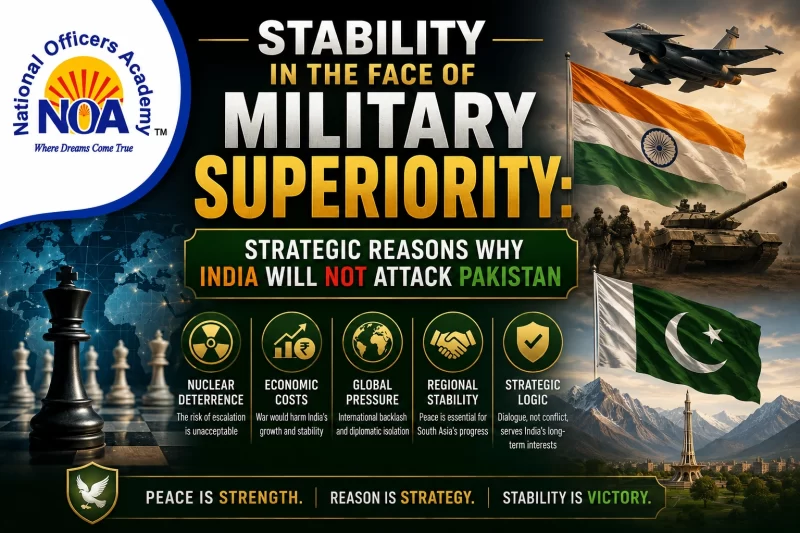
Stability in the Face of Military Superiority
Strategic Reasons Why India Will Not Attack Pakistan
Introduction
The India-Pakistan rivalry is one of the most intractable rivalries in the international system.
It is largely driven by history, territorial disputes, and national security concerns.
In the modern era, the military balance between the two nations has changed dramatically, particularly with the advent of nuclear weapons.
While India possesses a clear conventional advantage over Pakistan, the issue is far more complex than a simple military assessment.
A combination of strategic, political, and military factors heavily influences both nations’ decisions about the possibility of military conflict.
Many of these factors involve nuclear deterrence.
Despite conventional asymmetry, India has refrained from attacking Pakistan. This decision is underpinned by strategic stability, nuclear deterrence, and the threat of catastrophic escalation.
Nuclear Deterrence: The Primary Factor
Nuclear weapons have altered the calculus of conflict between India and Pakistan.
Both countries’ nuclear capabilities act as a powerful deterrent, making the costs of war extraordinarily high.
The devastating consequences of nuclear escalation deter any military engagement that could potentially spiral out of control.
India, despite its conventional superiority, is aware that any attack on Pakistan could trigger nuclear retaliation.
This could turn a conventional war into a catastrophic conflict capable of destroying both nations.
This reality firmly anchors the principle of mutual deterrence.
Both sides are aware that war would not only devastate them militarily and economically but also damage their global standing.
Deterrence Stability and Miscalculations
Nuclear deterrence has led to what is often referred to as “deterrence stability.”
In theory, the risk of nuclear escalation reduces the likelihood of full-scale war because both sides understand that the stakes are too high.
Yet, the stability-instability paradox explains another dimension.
While nuclear deterrence prevents all-out war, it may inadvertently encourage lower-level and limited conflicts.
These may include clashes along the Line of Control or proxy warfare, carried out under the assumption that they will remain below the nuclear threshold.
India’s conventional advantage may embolden it to engage in limited conflicts.
However, it refrains from full-scale war because it understands the ultimate consequences.
The Fear of Escalation: A Dangerous Cycle
One of the most critical reasons India refrains from launching a full-scale attack on Pakistan is the fear of escalation.
Even a limited conflict could trigger rapid escalation, leading to unintended nuclear war.
The history of both countries’ nuclear programmes and India’s stated “no first use” policy reinforce the idea that both states recognize the possibility of escalation at any point.
Pakistan’s nuclear capability is potent enough to deter a larger Indian military intervention.
India knows that a nuclear exchange would bring irreversible damage to both sides.
This is a scenario neither country can afford to face.
Limited Conventional Military Options for India
While India has a significant conventional military advantage, it faces challenges in fully exploiting this superiority.
Pakistan’s dense population and highly sensitive geography complicate large-scale military operations.
Any full-scale invasion would require massive mobilization.
The risk of international diplomatic isolation and the involvement of global powers would further complicate India’s military plans.
Limited military strikes, such as those conducted by India after incidents like Pulwama, are seen as more manageable forms of retaliation.
However, an all-out war remains an undesirable option because its outcomes are uncertain and potentially catastrophic.
The Role of Nuclear Thresholds in Military Strategy
The concept of nuclear thresholds further complicates India’s military options.
While India possesses a clear conventional advantage, it is aware that crossing Pakistan’s nuclear threshold would be disastrous.
Pakistan has developed a tactical nuclear weapons strategy as a deterrent against India’s conventional superiority.
Even limited military strikes from India could prompt a significant nuclear response from Pakistan.
As a result, India is forced to approach Pakistan with caution.
Its power is limited by Pakistan’s nuclear deterrent.
Third-Party Influence and Global Scrutiny
International powers, including the United States, Russia, and China, have historically played crucial roles in maintaining stability in South Asia.
During times of heightened tension, these countries encourage dialogue and de-escalation between India and Pakistan.
They recognize the potentially devastating effects of conflict between two nuclear-armed states.
India is acutely aware of the global implications of a full-scale war with Pakistan.
Such a war could invite economic sanctions, diplomatic backlash, or global condemnation.
This could undermine India’s international standing and long-term strategic goals.
Pakistan’s Counter-Deterrence: Conventional and Unconventional Options
While India may have superior conventional forces, Pakistan has developed a strategic doctrine that blends conventional deterrence with nuclear weapons, strategic depth, and asymmetric warfare tactics.
This doctrine allows Pakistan to defend itself without relying solely on conventional military power.
Pakistan has demonstrated resilience through proxy wars, hybrid warfare, and the use of unconventional tactics.
These options increase the cost of any Indian military action.
They force India to reconsider the potential consequences of a military campaign.
Geography of Pakistan and the Complexity of Conventional Warfare
Pakistan’s geography makes conventional military operations extremely challenging for India.
Its mountainous terrain in the north and urban centres in the south create major operational difficulties.
Urban warfare could result in heavy civilian casualties.
Such casualties would provoke international outrage and could increase pressure on Pakistan to use its nuclear deterrent.
Pakistan’s dense population centres and the potential for significant collateral damage further discourage India from choosing large-scale conventional military operations.
Pakistan’s Military Doctrine: Escalation Control and Counter-Attack Capability
Pakistan has developed a military doctrine that allows for the use of nuclear weapons at the tactical level to prevent an overwhelming conventional attack.
The presence of nuclear weapons at various levels of Pakistan’s military strategy provides a counter-deterrent to India’s conventional forces.
This ensures that any attempt to overwhelm Pakistan militarily would likely trigger a swift and devastating response.
The costs for India would increase significantly.
Thus, India’s conventional military advantage is mitigated by Pakistan’s credible nuclear deterrent.
The Psychological Factor: Deterrence and National Identity
Both nations have developed strong national identities tied to their military capabilities and nuclear arsenals.
India, with its conventional and nuclear military power, is deeply invested in maintaining the status quo.
Pakistan also perceives its nuclear deterrent as a core part of its national defence strategy.
The psychological effect of nuclear deterrence cannot be overstated.
Both sides operate under the belief that military confrontation would be catastrophic.
This belief reinforces the caution that underpins both countries’ strategies.
Political Stability and Domestic Considerations
Politically, Indian leadership must weigh the consequences of war not only in terms of international fallout but also domestic consequences.
Public opinion in a democratic country like India could turn decisively against any government that launches a full-scale military conflict with a neighbouring nuclear power.
Political leaders in India are aware of the internal instability that could arise from war with Pakistan.
This is especially important given India’s already delicate economic and social environment.
Economic Cost of War
A full-scale war with Pakistan would severely disrupt India’s economy.
India relies on stable international trade, investment, and market access.
The loss of stability would lead to long-term economic consequences.
It would affect domestic industries as well as international relations.
India’s economic growth is closely linked to regional stability.
War with Pakistan would not only reduce that stability but also negatively affect investor confidence.
The Role of Diplomacy: Channels of Communication
Both nations have established multiple channels of diplomatic communication.
These include back-channel talks and multilateral platforms aimed at preventing misunderstandings and reducing tensions.
Diplomacy allows both India and Pakistan to resolve crises through dialogue, thereby avoiding military escalation.
Despite numerous crises, India and Pakistan have often been able to de-escalate tensions through talks.
These efforts are sometimes mediated by third-party countries or international organizations such as the United Nations.
The International Norm Against Nuclear War
There is a strong international norm against the use of nuclear weapons.
India and Pakistan, despite their adversarial relationship, both recognize this norm.
Nuclear deterrence has become not just a bilateral issue but a matter of global security concern.
The international community strongly discourages any use of nuclear weapons because of the broader consequences of such a conflict.
India’s strategic thinking therefore involves maintaining its nuclear arsenal for deterrence purposes without crossing the nuclear threshold.
Pakistan’s Regional Partnerships
Pakistan’s strategic relationships with China, Saudi Arabia, and other key regional players provide an additional layer of deterrence.
China, in particular, serves as a balancing force against India’s conventional and nuclear superiority.
The possibility of Pakistani security guarantees and military support from its allies serves as a counterweight to India’s offensive capabilities.
This further discourages India from taking aggressive military action.
Uncertainty in Conventional Warfare Outcomes
Even though India has a clear conventional advantage, the uncertainty of conventional warfare against Pakistan is a significant factor.
Pakistan’s ability to mobilize asymmetric strategies, including cyber warfare, guerrilla tactics, and geographic leverage, would complicate any military campaign.
India would need to consider the possibility of prolonged conflict.
It would also need to consider the international ramifications of civilian casualties.
These uncertainties further deter India from launching a full-scale military operation.
Lack of Political Will for War
Finally, the lack of political will on both sides to escalate the situation into full-scale war plays a crucial role.
Both countries understand that war in a nuclearized environment could destroy any political, economic, or military gains they have made over the years.
India occasionally pursues limited military strikes.
However, it has not shown a willingness to escalate the conflict to a point where it risks nuclear retaliation.
Conclusion: Why Full-Scale War Remains Unlikely
Despite India’s overwhelming conventional military superiority, its reluctance to attack Pakistan stems from a clear understanding of nuclear deterrence and the severe risks of escalation.
India’s strategic thinking operates within the framework of deterrence stability, where the costs of war far outweigh the potential benefits.
The interplay of nuclear deterrence, geopolitical realities, domestic considerations, and global pressure all contribute to India’s cautious approach.
As long as both nations maintain their nuclear arsenals and strategic stability remains intact, a full-scale war remains unlikely.
This remains true despite the conventional asymmetry between India and Pakistan.