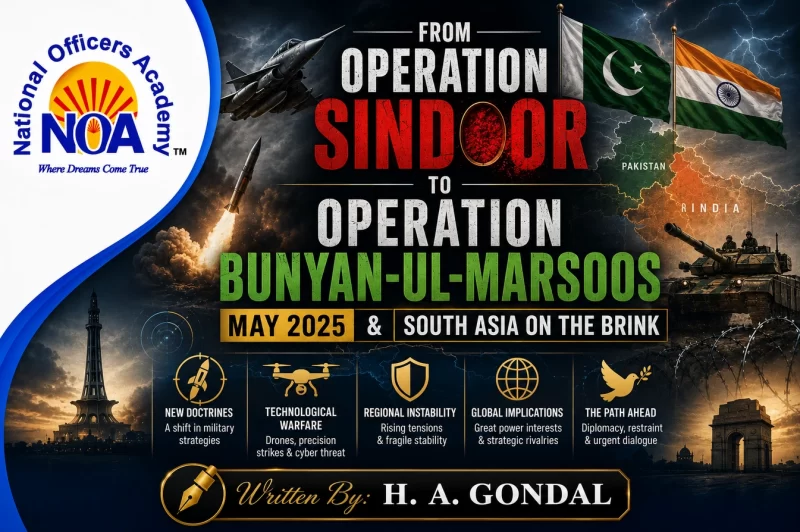
From Operation Sindoor to Operation Bunyan-ul-Marsoos
May 2025 & South Asia on the Brink
Written By: H A Gondal
Editor: NPRD
Introduction
The Indo-Pakistan stalemate in May 2025 has cemented South Asia’s status as one of the most dangerous security settings globally.
The crisis, initiated by India’s “Operation Sindoor,” intensified through missile strikes, drone warfare, and air operations, culminating in Pakistan’s counter-offensive, Operation Bunyan-ul-Marsoos.
This incident, unlike previous conflicts, featured concurrent engagements across various domains — military, diplomatic, and informational — illustrating that contemporary combat in a nuclearized region extends far beyond the battlefield.
Battlefield Escalation: From Sindoor to Bunyan-ul-Marsoos
India initiated a sequence of coordinated missile, drone, and aerial assaults against Pakistani territory on the night of May 6–7, 2025. This served as the initial catalyst for the confrontation.
One of the most provocative actions was the targeting of the Nauseri Dam, which is a component of the Neelum-Jhelum Hydropower Project.
In Islamabad, this attack was perceived as reckless and potentially catastrophic for civilian populations living in the surrounding areas.
India characterized these operations as a measured act of retaliation linked to terrorism, particularly emphasizing the Pahalgam incident in Indian Illegally Occupied Jammu and Kashmir.
New Delhi invoked counterterrorism in an effort to place its actions within the broader global security discourse.
Pakistan categorically rejected this narrative and characterized the strikes as illegal acts of aggression. Islamabad invoked its inherent right to self-defence under Article 51 of the UN Charter.
In addition to demonstrating operational readiness, the Pakistan Air Force’s rapid interception of Indian aircraft and drones sent a clear message of deterrence.
India’s military operations intensified on the night of May 9–10, provoking an even more serious confrontation.
Indian forces struck three significant Pakistani airbases — Nur Khan, Mureed, and Shorkot — using BrahMos missiles.
The targeting of strategic air installations represented a dangerous broadening of the conflict and revealed New Delhi’s willingness to test escalation thresholds.
Pakistan’s air defence systems effectively neutralized these strikes.
Pakistan’s response was both decisive and calculated. Islamabad initiated Operation Bunyan-ul-Marsoos on May 10, a counter-offensive that targeted 26 Indian military facilities, including BrahMos missile storage sites and an S-400 air defence system.
It is important to note that Pakistan’s attacks were limited to military infrastructure, avoiding civilian targets.
Pakistan’s actions strengthened its claim that it adheres to international legal norms while maintaining a credible deterrent posture.
By imposing tangible costs on India while structuring its actions within the parameters of lawful self-defence, Pakistan exhibited both capability and discipline in managing escalation during an acute crisis.
Global Alarm: Mediation and Diplomacy
The global reaction was prompt.
The United States, European Union, China, and Gulf states, including Saudi Arabia and Qatar, undertook vigorous mediation efforts. They urged both parties to avoid unrestrained escalation.
U.S. diplomatic initiatives ultimately achieved a truce on May 12, although violations were documented by both sides.
The episode demonstrated how rapidly Indo-Pakistani conflicts attract international attention. It also highlighted the nuclear dimension of their rivalry and the broader geopolitical implications attached to South Asian stability.
The Importance of Mediation and Global Alarm
The international response to the May 2025 standoff was prompt and coordinated.
This demonstrated the severity of the crisis and persistent global concern regarding nuclear stability in South Asia.
Key global actors, including the United States, European Union, China, and influential Gulf states such as Saudi Arabia and Qatar, engaged in urgent diplomacy within hours of escalation.
Their appeals consistently emphasized caution, reflecting recognition that even localized conflicts between India and Pakistan could rapidly escalate into a regional or global security crisis.
The United States played a critical role as one of the mediators.
Senior American officials, including the Secretary of State and Vice President, engaged with leadership in both Islamabad and New Delhi.
Their efforts culminated in the declaration of a ceasefire on May 12, which was subsequently verified by both governments.
Nevertheless, the ceasefire was imperfect, as both parties reported violations. Still, it averted the immediate threat of further escalation.
Despite India’s reluctance to formally acknowledge external mediation, Washington’s role in brokering this outcome underscored its continued influence in South Asia.
The diplomatic effort was further enriched by the participation of European and Gulf actors.
The European Union emphasized the importance of preventing destabilization in a region central to global trade and energy flows. It also stressed adherence to international law.
Saudi Arabia and Qatar served as trusted intermediaries with both Islamabad and New Delhi, reflecting their growing diplomatic involvement in South Asian crises.
China, which has historically supported Pakistan, also advocated de-escalation, indicating that the destabilizing potential of the conflict was not limited to bilateral boundaries but extended into wider Asian geopolitics.
The rapid and multi-directional diplomatic mobilization underscored one central reality: Indo-Pakistani crises cannot be contained within the subcontinent.
Every escalation between the two nuclear-armed states draws immediate attention from global powers, not only because of the possibility of deterrence breakdown but also due to broader geopolitical consequences.
Thus, the May 2025 confrontation confirmed that South Asia remains a critical junction where regional disputes intersect with international security priorities.
At the same time, the episode exposed the limits of external mediation.
Although the ceasefire temporarily restored calm, it failed to address the underlying causes of conflict — Kashmir, terrorism narratives, and resource disputes.
This leaves room for future crises.
For Pakistan, this creates both an opportunity and a challenge: to use international engagement for short-term stability while also pushing for institutional mechanisms that can ensure long-term conflict management.
It is now necessary to transition from reactive diplomacy to sustained international support aimed at resolving the structural drivers of Indo-Pakistani hostility.
Narratives of Power: Competing for Legitimacy
An analogous conflict also unfolded in the realm of information.
Indian officials characterized their strikes as “retribution with restraint,” highlighting counterterrorism efforts.
Pakistan responded with a diplomatic and media initiative emphasizing India’s aggression, its alleged support for proxies such as the Tehrik-i-Taliban Pakistan and Balochistan Liberation Army, and evidence of false-flag operations.
The competition for foreign opinion became pivotal in shaping external perceptions and affecting the reactions of significant global actors.
Conflicting Narratives: The Struggle for International Legitimacy
In addition to military conflict, an equally significant battle occurred in the information domain.
The strikes under Operation Sindoor were portrayed by Indian officials and media outlets as “retribution with restraint,” presenting them as carefully calibrated counterterrorism measures.
New Delhi sought to legitimize its actions globally and appeal to its domestic audience by framing the confrontation through the lens of terrorism.
Statements from Indian leaders and media coverage emphasized the Pahalgam incident as a rationale for military escalation and portrayed Pakistan as a consistent sponsor of militancy.
This narrative attempted to place the crisis within the broader global discourse on counterterrorism, allowing India to assert compliance with international norms.
Pakistan launched a multifaceted diplomatic and media campaign in response to India’s framing.
Islamabad emphasized the illegality of India’s actions, asserting that the assaults were unprovoked aggression against sovereign territory.
It also highlighted India’s alleged involvement in sponsorship of destabilization inside Pakistan through proxies such as the Balochistan Liberation Army and the Tehrik-i-Taliban Pakistan.
Pakistan published a dossier containing evidence of Indian complicity in hybrid warfare and false-flag operations.
The objective of this documentation was to expose New Delhi’s aggressive posture as a violation of international law and undermine its counterterrorism justification through strategic distribution to international partners and media outlets.
The conflict of narratives rapidly became a critical factor in shaping global responses.
India’s rhetoric was effective in appealing to its domestic constituency. However, it failed to persuade many international actors due to the lack of verifiable evidence linking Pakistan to the Pahalgam incident.
In contrast, Pakistan’s emphasis on proportionality, legal principles, and exposure of Indian proxy networks resonated more broadly with external stakeholders.
Global powers adopted a more balanced approach inclined toward de-escalation rather than unqualified endorsement of India’s claims.
This aspect of the crisis emphasizes the increasing importance of perception management in contemporary deterrence.
In an environment where international legitimacy can influence the scope and direction of diplomatic mediation, the capacity to create and sustain credible narratives has become as essential as battlefield performance.
For Pakistan, the episode demonstrates the strategic importance of investing in coordinated media, diplomatic, and public diplomacy campaigns that can effectively challenge adversarial narratives.
Winning the war of narratives will be essential for securing long-term diplomatic credibility and tactical advantage in future South Asian crises, which are expected to involve parallel battles in both kinetic and epistemic domains.
Systemic Shifts: Drones, Water, and Information Warfare
The May 2025 standoff underscored three systemic transformations in South Asia’s security dynamics.
First, the growing dependence on drones, loitering munitions, and missile systems has obscured the distinction between frontlines and civilian areas, transforming entire national territory into a potential combat zone.
Second, India’s choice to suspend the Indus Waters Treaty transformed water into a possible tool of coercion, creating significant humanitarian and strategic ramifications.
Third, the significance of information warfare established that management of global perceptions is essential to contemporary deterrence.
The Emergence of Drone and Missile Warfare: Blurring of Frontlines
The confrontation of May 2025 illustrated how modern warfare has weakened the traditional distinction between frontlines and civilian spaces.
India’s use of drones, loitering munitions, and cruise missiles extended the battlefield deep into Pakistan’s territory.
Targets ranged from civilian areas in Sindh to air defence sites in Lahore.
For Pakistan, the challenge was not only technical but also strategic: safeguarding dispersed assets from low-signature, fast-moving aerial threats that tested conventional radar and air defence systems.
Pakistan’s downing of 25 Indian drones through a combination of soft-kill and hard-kill technologies underscored both its expanding defensive capabilities and the potential for escalation.
Even minor intrusions now carry the risk of disproportionate responses.
These developments suggest a fundamental change in the nature of deterrence in South Asia.
In previous crises, escalation was often restricted to border regions or contested spaces along the Line of Control.
By contrast, the use of precision missiles and drones has turned the entire country into a potential combat zone, increasing the vulnerability of civilian populations and national infrastructure.
This transformation requires a thorough reevaluation of Pakistan’s defence architecture.
This includes investment in integrated air and cyber defence, dispersion of critical assets, and resilience planning for civilian infrastructure.
The blurring of frontlines complicates escalation management and raises the stakes of every exchange, bringing both parties closer to the nuclear threshold.
The Crisis of the Indus Waters Treaty: Weaponizing Water
During the crisis, India’s decision to suspend its obligations under the Indus Waters Treaty signaled a dangerous expansion of coercive instruments in the bilateral conflict.
The Indus Waters Treaty had endured decades of hostility and conflict and was long considered one of the most durable water-sharing agreements in the world.
By holding the treaty in abeyance, India introduced water as a weapon of strategic leverage, threatening to deprive Pakistan’s 250 million citizens of a critical resource.
Islamabad warned of catastrophic repercussions, emphasizing that the weaponization of water could destabilize the region for generations.
This maneuver indicated New Delhi’s readiness to expand the scope of conflict beyond the military domain into economic and humanitarian domains, increasing the likelihood of a prolonged conflict.
For Pakistan, the suspension of the treaty highlights the need to internationalize the water issue.
Diplomatic engagement at the United Nations, World Bank, and other forums is essential to reaffirm the legal sanctity of the treaty and expose the broader risks of undermining an internationally guaranteed framework.
A legally robust and technically resourced team must be mobilized to challenge India’s narrative and prevent the progressive normalization of treaty violations.
Alongside legal mechanisms, Pakistan must also invest in domestic water management reforms to reduce vulnerabilities.
The inclusion of water in the Indo-Pak dispute not only worsens existing fault lines but also elevates a bilateral dispute into a global concern related to humanitarian stability and resource security.
The Struggle for International Opinion: Narratives of Power
The crisis was fought in the domain of ideas as much as in the skies.
Indian officials reinforced the narrative of Pakistan as a perpetual sponsor of militancy and characterized their strikes as a measured response to terrorism.
This message was amplified by Indian media, which highlighted statements made by militant leaders and claims of strikes against alleged terrorist camps.
Pakistan responded with its own narrative of victimhood, portraying itself as a responsible actor committed to proportionate defence.
Islamabad’s assertion that India was destabilizing the region under the guise of counterterrorism was further strengthened by the publication of a comprehensive dossier on Indian false-flag operations and external sponsorship of proxies such as the TTP and BLA.
In shaping the response of external actors, this contest for international opinion proved decisive.
Although Indian rhetoric resonated with its domestic audience, global powers were not persuaded by its narrative, particularly in the absence of verifiable evidence linking Pakistan to the Pahalgam incident.
Pakistan’s emphasis on restraint and adherence to international law resonated more broadly, resulting in diplomatic goodwill and mediation support.
The episode emphasized the central role of information warfare in contemporary deterrence.
The ability to characterize actions as legitimate or illegitimate can influence global intervention and shape post-crisis outcomes.
In future crises, Pakistan will need to strengthen strategic communication and deepen engagement with international think tanks and media platforms.
Enduring Fault Lines: Fragile Deterrence in South Asia
The crisis affirmed Pakistan’s military readiness, elevated its diplomatic status, and strengthened its deterrent capabilities.
Nonetheless, persistent conflicts around Kashmir, terrorism narratives, and resource allocation remain unresolved.
The May 2025 clash revealed enduring destabilizing fault lines and the pressing necessity for institutional measures to regulate escalation between the two nuclear neighbours.
Deterrence and the Need for Institutionalized Escalation Management
Pakistan’s military readiness and operational effectiveness were both demonstrated during the May 2025 crisis.
The Pakistan Air Force’s capacity to intercept a substantial number of drones and down multiple Indian aircraft, including sophisticated platforms, demonstrated a qualitative advantage in defensive preparedness.
The successful execution of Operation Bunyan-ul-Marsoos, which targeted strategic Indian assets while avoiding civilian casualties, further bolstered the credibility of Pakistan’s doctrine of proportionate response.
Islamabad was able to re-establish deterrence without crossing thresholds that could have led to uncontrolled escalation or loss of international legitimacy.
By maintaining a balance between military strength and restraint, Pakistan enhanced its reputation as a disciplined military actor capable of countering aggression while adhering to standards of responsible state behaviour.
Pakistan’s diplomatic credibility was also significantly improved.
It was viewed as the more responsible actor due to its proactive use of multilateral forums, swift engagement with international partners, and dissemination of evidence regarding Indian false-flag operations.
Global powers were unconvinced by India’s narrative, which attempted to portray the crisis as an extension of counterterrorism without verifiable evidence.
Instead, the United States, China, and Gulf states responded more positively to Pakistan’s emphasis on proportionality, adherence to international law, and willingness to engage in dialogue.
The international goodwill generated by this approach helped de-escalate the immediate crisis and highlighted the potential of Pakistan’s diplomacy as a counterweight to India’s regional ambitions.
However, deeper structural disputes remain unresolved.
Kashmir remains the most combustible and central fault line, with India refusing to acknowledge it as an international dispute and Pakistan insisting on its resolution under UN Security Council resolutions.
Terrorism narratives also remain contested. India continues to portray Pakistan as a state sponsor of militancy, while Pakistan accuses India of financing and directing proxy groups such as the Tehrik-i-Taliban Pakistan and the Balochistan Liberation Army.
This conflict of narratives ensures that future crises will persist, driven by strategic hostility and mistrust.
The issue of resource allocation is equally urgent, particularly in light of India’s suspension of the Indus Waters Treaty.
The use of water as a coercive instrument has intensified the conflict by adding a humanitarian and ecological dimension.
For Pakistan, mobilizing international legal and diplomatic support and defending its rights under the treaty will be imperative.
Without such measures, the potential weaponization of water resources could become a persistent source of instability alongside the unresolved Kashmir dispute.
The security environment of South Asia is characterized by enduring destabilizing dynamics, as evidenced by the events of May 2025.
In the absence of mechanisms to regulate escalation, deterrence remains fragile despite being momentarily restored.
The crisis emphasized the urgent need for institutionalized frameworks between the two nuclear neighbours, whether through confidence-building measures, renewed DGMO mechanisms, or third-party facilitated talks.
Such measures can help manage crises before they spiral out of control.
Without such arrangements, each confrontation risks approaching the nuclear threshold, increasing costs not only for Pakistan and India but also for regional and global stability.
SWOT Analysis of Pakistan’s Response
Strengths
Military Readiness and Operational Success
- Pakistan Air Force downed multiple Indian aircraft, including Rafales confirmed by French sources, and intercepted drones and missiles effectively.
- Successful execution of Operation Bunyan-ul-Marsoos targeting 26 Indian military sites, including BrahMos storage and S-400 systems, restored the balance of deterrence.
- Pakistan demonstrated the capacity to neutralize swarm drone attacks, shooting down at least 25 drones through both soft-kill and hard-kill technologies.
Diplomatic Credibility
- Pakistan positioned itself as a responsible actor by limiting strikes to military targets, avoiding civilian casualties, and stressing proportionality.
- Islamabad earned goodwill by invoking international law, especially Article 51 of the UN Charter, and exposing Indian false-flag operations through dossiers.
- Active diplomatic outreach, including delegations led by Bilawal Bhutto, Ishaq Dar, and others, countered India’s global lobbying efforts.
Narrative Advantage
- The international community rejected India’s unsubstantiated claims linking Pakistan to the Pahalgam incident.
- Pakistan effectively highlighted India’s alleged sponsorship of TTP and BLA terrorism and the illegality of weaponizing water resources.
- Pakistan’s media strategy portraying the country as a victim of unprovoked aggression resonated globally, leading to more balanced coverage compared to past crises.
Weaknesses
Economic Fragility
- Pakistan entered the crisis with an already fragile economy, making it vulnerable to external pressure, potential sanctions, and IMF-related complications.
- Indian attempts to influence IMF support for Pakistan by linking funds to “terror financing” narratives highlighted Islamabad’s dependency.
Internal Vulnerabilities
- Political disunity, economic instability, and social divisions risked being exploited by India during the crisis.
- Lack of long-term preparedness for drone and missile saturation attacks exposed gaps in Pakistan’s defence architecture.
- Continued reliance on reactive diplomacy rather than institutionalized escalation management limited crisis endurance.
Information Ecosystem Constraints
- Although Pakistan performed better than in past crises, India’s larger international media reach and lobbying capacity posed challenges.
- Pakistan still lacks sustained strategic communication infrastructure to counter India’s epistemic dominance consistently.
Opportunities
Strengthening Deterrence Posture
The successful neutralization of Indian strikes and Pakistan’s proportionate counter-offensive restored credibility to Pakistan’s deterrent capabilities.
This provides an opportunity to invest in next-generation air defence, drone countermeasures, and cyber warfare systems.
Diplomatic Leverage
International mediation reaffirmed Pakistan’s importance to regional stability.
This allows Islamabad to capitalize on goodwill and push for institutionalized crisis management mechanisms such as DGMO frameworks or NSA-level dialogues.
The re-hyphenation of Indo-Pak issues, including Kashmir and water-sharing, has returned these disputes to international attention.
Narrative Consolidation
Pakistan’s dossier diplomacy and emphasis on restraint created space for expanding influence in global think tanks and policy circles.
By internationalizing India’s suspension of the Indus Waters Treaty, Pakistan can build alliances with other water-stressed states and multilateral institutions.
Internal Reforms
The crisis highlighted the urgent need for economic stability, political reconciliation, and national unity.
Leveraging lessons from the standoff can encourage reforms that strengthen Pakistan’s resilience against external coercion.
Threats
Future Indian Escalation
- India may seek to restore “lost prestige” by escalating in new domains, including deeper air operations, covert cyberattacks, or proxy warfare through the TTP and BLA.
- The crisis has increased the likelihood of India treating pre-emptive or punitive strikes as a “new normal,” raising the risk of miscalculation.
Proxy and Hybrid Warfare
- After the crisis, India is likely to expand support for insurgent groups and increase sub-conventional pressure on Pakistan’s internal security.
- Hybrid threats, including cyber operations, information manipulation, and economic leverage, are likely to intensify as non-kinetic extensions of military confrontation.
Weaponization of Resources
- India’s suspension of the Indus Waters Treaty sets a dangerous precedent.
- If normalized, water could become a recurring instrument of coercion, threatening Pakistan’s food and energy security.
International Financial Pressure
- India’s lobbying at the IMF and potential FATF review challenges represent significant vulnerabilities.
- Any economic isolation could undermine Pakistan’s ability to sustain military readiness in prolonged crises.
Towards a Resilient Security and Diplomacy Framework
The May 2025 standoff emphasized the need for Pakistan to convert its demonstrated military resilience into a sustained and comprehensive strategy.
Pakistan must prioritize the modernization of air and drone defence systems, strengthen cyber deterrence, and guarantee the dispersal of critical assets to withstand saturation attacks.
Economic resilience must also be treated as a fundamental component of national security.
Adversaries should not be allowed to exploit internal vulnerabilities. This requires structural reforms, reduced dependence on external financing, and political reconciliation.
It is equally important to institutionalize crisis management mechanisms.
These may include reviving DGMO hotlines, expanding NSA-level engagements, or advocating for third-party guarantees to prevent uncontrolled escalation.
Pakistan should capitalize on the goodwill it acquired during the crisis to strengthen international law as the foundation of its interactions with India.
The weaponization of water, proxy warfare, and unilateral strikes must be consistently internationalized at the United Nations, World Bank, and global think tanks.
To counter India’s narrative dominance, Pakistan needs sustained engagement with global policy circles and investment in professionalized strategic communication.
At the same time, Pakistan should establish regional coalitions with China, Turkey, and Gulf states.
These partners should not merely act as mediators but should also contribute to the development of a long-term stability architecture for South Asia.
By integrating proactive diplomacy, internal reforms, and robust defence preparedness, Pakistan can reduce the likelihood of future crises and convert tactical victories into durable strategic gains.